.png)
.png)

Daniel Saks
Chief Executive Officer


.png)

Lookalike modeling is a machine learning approach that identifies new B2B accounts sharing key attributes with a company's best existing customers. The model takes 5-50 closed-won customers as seed data, analyzes the firmographic, technographic, behavioral, and engagement patterns those accounts share, then surfaces companies in the addressable market that match those patterns. The output is a prioritized list of net-new accounts the team has not yet found through inbound or manual prospecting.
According to research on B2B prospecting effectiveness, traditional firmographic filtering misses 30-50% of viable accounts because the patterns that predict conversion are not always visible in industry codes or employee count. Lookalike modeling closes this gap by evaluating the multi-dimensional signal patterns of best customers rather than relying on category descriptions.
Quick answer: Lookalike modeling for B2B works by analyzing your closed-won customers across firmographic, technographic, and behavioral dimensions, then finding companies in the broader market that match those multi-dimensional patterns. Unlike B2C lookalike audiences (which match consumer demographics), B2B lookalike modeling matches business attributes that predict purchase decisions.
“Lookalike modeling” is a marketing analytics technique that identifies new prospects who closely resemble your best existing customers. In simpler terms, it’s about finding “the next you” – the next accounts or buyers that share the key traits of your ideal customer profile (ICP). This practice first rose to prominence in B2C digital marketing (think of finding consumers similar to your current buyers for targeted ads ), but it’s equally transformative in B2B contexts where the stakes of each customer relationship are higher.
In B2B lookalike modeling, the focus is often on accounts (companies) as much as individuals. A lookalike model will analyze your top customers – for example, your highest lifetime-value clients or fastest deals won – and pinpoint the attributes that make them great customers. Those attributes could include firmographics (e.g. industry, company size, location), technographics (the tech stack or tools they use), growth signals (hiring rate, funding rounds), intent indicators (web content consumption, product research behavior), and more. The model then searches a broad universe of companies and contacts to find those that match this “ideal” profile, essentially cloning your best customers on paper.
Crucially, lookalike modeling in the age of AI goes beyond surface-level similarities. It’s not just filtering by one or two attributes; it’s discovering patterns across dozens or even hundreds of data points. For instance, you might learn that many of your best SaaS clients are in a specific sub-industry, use a certain combination of cloud platforms, have recently raised Series B funding, and are expanding their sales teams. A lookalike algorithm will seek out other companies with that complex “fingerprint”. As Salesforce’s marketing team describes it, this approach “pinpoints the core characteristics of a target audience and identifies potential new members that display similar attributes or behaviors”. In essence, the model asks: “Who out there looks and acts like my best customers?” – and then helps you market or sell to them.
1. Seeding the Model with Your ICP: The process starts with defining your ideal customer profile. This could mean compiling a list of your top customers or highest-value deals from your CRM. You might export the accounts that had the largest contract values, fastest sales cycles, or strongest product usage. These are the “seed” data points for the lookalike model. In practice, modern platforms make this easy – you can often upload a CSV of your best customers or even just describe your ICP in natural language (e.g. “Series B fintech companies in the US with >50 employees”). The key is to give the model a clear picture of who your ideal customer is.
2. Analyzing Key Characteristics: Next, the lookalike modeling system (usually powered by AI/ML algorithms) will analyze the seed customers to identify the traits that set them apart. This isn’t a manual exercise – the AI might evaluate hundreds of features across each company, from basic firmographics to nuanced behaviors. For example, Landbase’s GTM Omni model (an AI built for GTM tasks) compares over 1,500 signals (firmographic, technographic, intent, hiring trends, etc.) to determine what truly distinguishes your best customers. It essentially learns the hidden patterns: maybe your top clients tend to be hiring aggressively for certain roles, or they all use a specific cloud infrastructure, or they show spikes in product engagement. This step is critical – a robust lookalike model looks beyond obvious traits and finds the combination of attributes that correlate with customer success.
3. AI Pattern Matching to Find Lookalikes: Once the model understands the ICP pattern, it scans a broad database of potential prospects to find the closest matches. This is where AI shines – it can comb through millions of companies and contacts in seconds, far beyond human capacity. Each prospect account is scored or evaluated on how closely it resembles the seed profile. Think of this like a similarity ranking: if your ideal customers all share 5-10 key traits, the AI will surface other accounts that have those same traits in common. According to Gartner, lookalike modeling is emerging as a powerful AI-driven practice for B2B marketing and sales, precisely because it automates the identification of qualified leads that fit your proven success profile. Instead of relying on guesswork or static filters, the AI finds “pattern matches” – sometimes revealing lookalikes you wouldn’t have thought to target on your own. (For example, you might discover an entirely new vertical that mirrors your best customers’ characteristics, indicating an untapped market.)
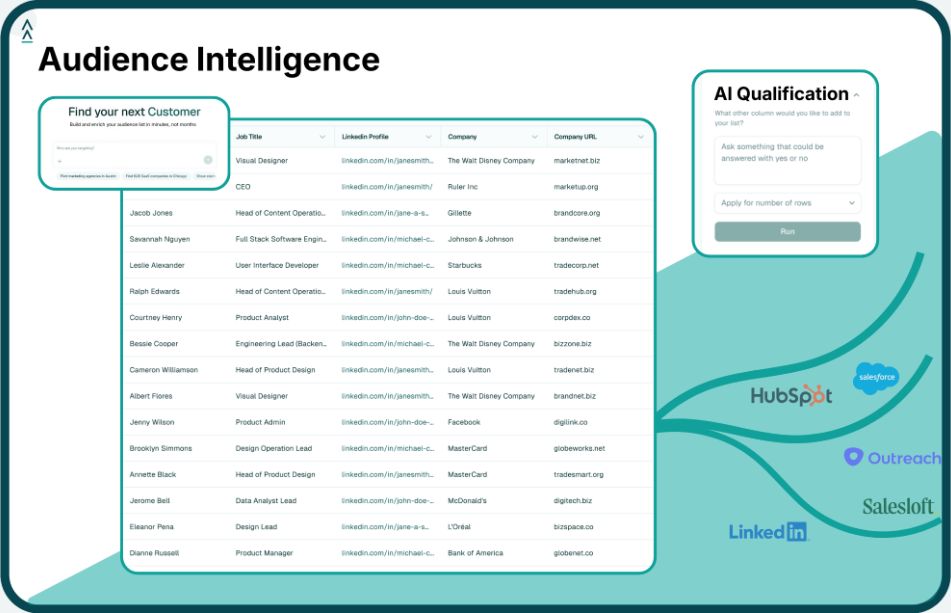
Notably, advanced platforms like Landbase do this via agentic AI – the AI not only searches for matches but can also interpret natural-language prompts and refine results interactively. Landbase’s system will even tell you in plain English what it’s doing (e.g. identifying companies with certain attributes) and adjust if you clarify your criteria. This makes the process accessible to non-technical users: a Head of Sales can simply ask for “companies that look like our top 10 customers” and get a ready-to-use list.
4. Qualification and Enrichment: Raw lookalike output is a great start, but GTM teams need actionable results – which means ensuring the data is accurate and enriched with the right contacts. At this stage, it’s common to apply AI qualification filters to the lookalike list. AI qualification involves evaluating each surfaced account against specific criteria (for fit and timing) and even scoring them. For instance, if your sales team only sells in North America, a qualification step might automatically flag or remove lookalikes outside your territory. More advanced AI qual can dig into whether each account truly has the pain point your solution addresses (using intent data or web research).
Just as important is data enrichment: attaching the relevant decision-maker contacts and supplemental info to each lookalike account. A list of company names isn’t very useful if you can’t reach the stakeholders. Modern tools will therefore append verified contact information (email, phone, LinkedIn) for key titles at each target account, along with contextual data like recent news or intent signals. The goal is to hand your sales or marketing team a fully baked target list, not a homework assignment.
It’s worth noting that the highest-performing workflows combine automation with a human touch here. Some platforms offer an “offline enrichment” or human-in-the-loop step – if the AI isn’t 100% confident on a match or can’t find certain data, a research team will manually verify and enhance the results before final delivery. Landbase, for example, employs Offline AI Qualification done by its data team for any tricky cases the AI can’t perfectly resolve, ensuring over 90% data accuracy on the final lookalike list. This hybrid approach gives GTM teams confidence that the lookalike recommendations aren’t just similar on paper, but truly high-quality and up-to-date. (No one wants to pursue an account that looked similar but actually has outdated info or no real need.)
5. Activation – Using the Lookalike Insights: The final step is turning the lookalike model output into GTM action. For sales teams, that might mean importing the list of lookalike accounts and contacts into your CRM or sales engagement tool for outreach. For marketing, it could mean creating audience segments in your marketing automation or ad platforms (e.g. uploading a list to LinkedIn for an account-based advertising campaign). Some platforms let you export thousands of vetted contacts with one click, making it easy to activate campaigns immediately.
Beyond just list-building, take advantage of the insights from lookalike modeling. The patterns that the model identified can inform your overall strategy. For instance, if the lookalikes show a cluster in a new industry or region you hadn’t targeted before, that signals a potentially lucrative market segment to pursue. Landbase’s platform highlights these emerging clusters – essentially showing you whitespace opportunities where many similar companies exist that you haven’t tapped yet. In this way, lookalike modeling isn’t just a one-off exercise, but an ongoing strategic guide for market expansion. It helps GTM teams refine their ideal customer definitions, prioritize accounts showing buying signals, and ensure no high-potential segment slips under the radar.
Finally, as you activate lookalike audiences, it’s good practice to loop back and measure results. Do the lookalike accounts convert at higher rates? Are sales cycles shorter when selling to lookalikes? Use these feedback signals to further tune your model (many AI-driven systems will learn and improve as you feed in outcome data). This creates a virtuous cycle: your targeting becomes progressively smarter and more precise over time.
For sales teams, lookalike modeling is like adding rocket fuel to prospecting. A common pain point for sales reps is spending huge chunks of time on unproductive outreach – chasing leads that go nowhere. In fact, research shows sales representatives waste ~500 hours per year (62 full days!) dealing with bad prospect data and dead-end contacts. That’s time they could spend closing deals. Lookalike modeling directly tackles this inefficiency by zeroing in on prospects that are likely to be good fits, because they resemble those deals you’ve already won.
How Sales Can Use Lookalikes: Imagine your Sales Development Rep (SDR) team just closed a handful of great customers in the cybersecurity sector. With lookalike modeling, they can input those recent wins (or simply specify the traits – e.g. “cybersecurity companies in healthcare, 100-500 employees, using AWS”) and instantly get a tailored list of similar companies to target next. Instead of calling down a generic list or territory, your reps are calling “the companies most likely to become our next customers.” This accelerates pipeline generation dramatically – reps spend their time on high-probability targets rather than spray-and-pray prospecting.
The impact is measurable. When sales orgs embrace data-driven prospecting methods like lookalike modeling, they see better outcomes. McKinsey reports that companies leveraging AI for sales (including predictive targeting) achieved ~50% increase in leads and appointments, while cutting cost-to-acquire by 40–60%. Reps simply have more productive conversations when the account is a good fit to begin with. It’s no surprise that sellers who effectively partner with AI tools are 3.7× more likely to meet their quotas than those who stick to old-school methods. Lookalike modeling is a prime example of an AI tool that gives reps an edge – by algorithmically finding the “low-hanging fruit” in a vast market, it loads the dice in favor of the seller.
Example – Expanding a Sales Territory: Let’s say you’re an Account Executive covering the Midwest region, and you’ve had major success closing automotive manufacturing clients for an ERP software. After a few wins, the well of obvious prospects might run dry. Using a lookalike model, you could upload your client list and discover, for instance, that automotive electronics suppliers in neighboring states share a similar profile to your best customers. The model might return 50 lookalike companies (with key contacts) that weren’t even on your radar – but fit the bill closely in terms of size, tech needs, and growth stage. You now have a fresh, data-validated call list. This beats the typical approach of blindly calling every manufacturer in your patch. It’s precision prospecting.
Shortening the Sales Cycle: Another benefit is that deals from lookalike accounts tend to progress faster. Since these prospects often have the same pain points and characteristics as your existing customers, your sales team can use relevant case studies and references to build credibility quickly. The conversation is more resonant (“we work with companies just like yours on this issue”). Moreover, lookalikes may already be in a buying mindset – for example, if the model incorporated intent data, your reps will be calling companies that have been researching similar solutions or have recent funding (signals that they’re primed to invest). All of this can shorten the sales cycle and increase close rates.
In short, lookalike modeling helps sales teams work smarter, not just harder. It front-loads the pipeline with quality. Reps will tell you that a smaller list of well-targeted accounts beats a massive list of random leads any day. The numbers back it up: focused account strategies like this are linked to bigger deals and higher win rates. (Notably, account-based marketing studies show average contract values increased 171% when companies focused on targeted account strategies over “volume” approaches – a testament to the power of concentrating on the right prospects.) By giving your sales team a data-driven map of where the best opportunities lie, lookalike modeling lets them spend time where it counts: building relationships with likely buyers and filling the pipeline with deals that close.
Marketing teams are under constant pressure to improve campaign ROI and drive high-quality leads to sales. Lookalike modeling provides a powerful lever here by enhancing both targeting precision and audience expansion in marketing campaigns. In essence, it helps marketers answer: “Who should we be marketing to, and how do we find more people just like our best customers?”
Refining Target Audiences: Every marketer knows the pain of pouring budget into ads or content syndication, only to attract junk leads that sales rejects. Lookalike modeling minimizes this waste. By analyzing the attributes of your best-converting customers, marketing can refine audience criteria for campaigns – whether it’s an email nurture, a LinkedIn ad, or an event invite list. For example, instead of a broad webinar invite to all tech companies, a marketer might use a lookalike list to only target tech companies that resemble our top 10 buyers. This means your message is reaching those who are most likely to resonate with it, resulting in higher response and conversion rates. One case study by a data provider illustrated this starkly: a custom lookalike model drove a 250% higher response rate and a 69% lower cost-per-acquisition compared to a standard broad campaign. The lookalike-targeted prospects were fundamentally more receptive, so they engaged at much higher rates, and marketing spent far less money to acquire each customer.
Scalable Audience Expansion: On the flip side of precision is scale – and lookalike modeling helps you scale smartly. When growth is the mandate, marketing often needs to expand into new audiences. The risk is expanding blindly and diluting lead quality. Lookalike modeling allows scalable expansion without sacrificing fit. By finding thousands of accounts that match your ICP, you effectively get a blueprint to grow your total addressable market with high-fit lookalikes. For instance, a marketing director can take a successful customer segment (say, mid-market hospitals using a healthcare IT product) and have the model output hundreds more hospitals or healthcare systems with similar profiles to feed into top-of-funnel campaigns. You’re not guessing at what new accounts might be interested – you have data-driven evidence that these lookalikes share key traits with your best customers, hence they’re worth targeting.
Use Case – Lookalike-Powered ABM: Account-Based Marketing (ABM) is a popular strategy where marketing tailors efforts to specific high-value accounts. Lookalike modeling is like ABM on steroids. ABM typically starts with identifying target accounts – often a manual and subjective process. With a lookalike approach, you can systematically generate an ABM target list by asking, for example, “Give me 200 companies that look like our top 5 enterprise clients.” The model might reveal new accounts that your ABM team hadn’t considered but fit the profile. Once you have those accounts, marketing can deploy personalized outreach (custom ads, direct mail, etc.) to engage them. Because the accounts are lookalikes of customers you’ve already closed, you can craft very tailored value propositions. This approach merges the best of both worlds: the personalization of ABM with the data-driven rigor of AI. It’s no surprise that marketing teams who embrace these data-driven targeting methods see significantly better outcomes – higher engagement and bigger deals. In fact, companies adopting ABM (which is essentially focusing on best-fit accounts) have reported substantial lifts in revenue; for example, average deal sizes can grow by 50%+ and overall marketing-sourced revenue can increase by 200%, thanks to focusing on the right accounts.
Campaign Optimization and Messaging: Another benefit for marketers is in messaging strategy. By understanding the common attributes of your lookalike audience, you can tailor content that speaks directly to their situation. If the model tells you that your best customers (and thus your lookalikes) often share a certain pain point – e.g. all your top clients struggle with data compliance – your campaign messaging can double down on that theme. This relevance boosts conversion. Salesforce’s research found 54% of customers feel companies don’t use data to benefit them (e.g. sending irrelevant messages). Lookalike modeling arms you with data so you can benefit the customer – by ensuring the content they see is highly relevant to their profile. In practice, marketers using lookalike insights might create segmented content tracks or tailor ad creatives that mirror the language of their best customers’ industry and needs.
Finally, lookalike modeling helps marketing optimize spend allocation. Since you can attribute which lookalike segments produce better leads or opportunities, you might discover (for example) that companies matching Signal A + Signal B have twice the conversion rate as others. You can then allocate more budget to channels reaching those high-converting lookalikes, and less to broader spends. Over time, this data-driven refinement can significantly lower your customer acquisition cost (CAC) and increase marketing ROI. It’s all about investing in the audiences most likely to pay off – and lookalike modeling gives you the map to find them.
Revenue Operations (RevOps) teams sit at the intersection of sales and marketing data, strategy, and analytics. One of their crucial responsibilities is defining the Total Addressable Market (TAM) and ensuring go-to-market focus is on the right segments. Lookalike modeling is an invaluable tool in the RevOps arsenal for data-driven TAM definition, territory planning, and ongoing account segmentation.
Data-Driven TAM Mapping: RevOps leaders often need to answer big strategic questions like “How many potential customers fit our ideal profile in North America?” or “What does our whitespace look like in X vertical?” Traditionally, answering these meant combining purchased lists, industry reports, and a lot of manual research – and even then, you risked missing chunks of the market. With lookalike modeling, RevOps can take the guesswork out of TAM. By feeding the ICP criteria into a model, you can instantly map out the universe of lookalike accounts that match your ideal profile. For example, a RevOps analysis might reveal there are 480 companies worldwide that are “very close” matches to our current enterprise customer profile. This not only quantifies TAM in a tangible way, but also provides the actual list of those accounts, which can be divvied up into territories or target lists for sales and marketing. One RevOps leader described using Landbase’s platform to do exactly this – e.g. identify all Series A–B tech companies in the AI DevTools space with >$10M funding as a way to size a new market segment. The lookalike model output guided their strategy on where the next expansion could be most fruitful.
Intelligent Segmentation and Scoring: Beyond big-picture TAM, RevOps is tasked with segmenting accounts (e.g. tiering target accounts into A/B/C categories, or assigning account scores). Lookalike modeling provides a built-in way to score accounts by similarity to ICP. If an account comes out as a 98% match to your best customers, that’s likely an “A-tier” target. RevOps can use these similarity scores to enforce focus – ensuring that sales spends more effort on the highest-scoring accounts. It’s a data-backed method to do lead/account scoring, as opposed to the subjective or simplistic point systems of the past. Moreover, as market conditions change, RevOps can rerun lookalike analyses to see if new types of companies are emerging into the ideal profile (maybe a new industry is popping up as a strong match). This helps keep segmentation dynamic and aligned with reality.
Keeping Data Fresh: A perennial RevOps challenge is maintaining data quality and CRM hygiene. It’s hard to make strategic decisions when your data is outdated. We noted earlier that 70% of CRM data can go bad annually and that a majority of RevOps and ops teams cite manual data cleanup as a major time sink. Lookalike modeling, coupled with continuous enrichment, offers a remedy. Because the model pulls from up-to-date data sources and signals (often including real-time web data), the lookalike output can serve as a refreshed view of the market. For instance, if a company in your target list underwent a big change (like a merger or a pivot), a fresh lookalike analysis might drop it out and replace it with a better fit account that emerged. In this way, the lookalike model acts as an “auto-curation” mechanism for your target account list. RevOps teams can set up periodic lookalike refreshes to ensure the sales team always has a current, relevant pool of targets and isn’t working off last year’s data. This significantly reduces the manual janitorial work (the dreaded CRM cleanup spreadsheets) and lets RevOps focus on strategy and enablement.
Example – Territory Planning: Consider a RevOps manager tasked with reassigning sales territories for a new fiscal year. Instead of distributing accounts evenly by sheer number or geography alone, they could use lookalike scoring to distribute opportunity. Perhaps territory A has 100 lookalike accounts above a certain quality threshold, and territory B has 120 – the territories might be balanced as is. But if territory C only has 50 high-lookalike accounts, RevOps might know to assign additional market segments or give that rep a secondary industry to cover. This data-centric approach to territory design ensures each rep has a fair shot at quota because the quality of their patch is quantified. It’s a more sophisticated method than simply counting logos in a region.
Strategic Alignment: Finally, RevOps can use insights from lookalike modeling to facilitate alignment between sales and marketing. When both teams see the data on what ideal customers look like and agree on a target list of lookalike accounts, it creates a unified focus. Marketing can concentrate campaigns on those accounts while sales works them as well – a true account-based approach. RevOps often provides the single source of truth; with lookalike modeling, that truth is grounded in AI-analyzed data rather than opinions. It shifts discussions from “I feel we should go after finance industry this quarter” to “Data shows finance companies with X profile are 2× more likely to convert – let’s prioritize those.” This kind of alignment can boost overall GTM efficiency and ensure resources are allocated to the best opportunities.
In summary, for RevOps teams, lookalike modeling is a powerful ally in building a data-driven go-to-market strategy. It quantifies your market, keeps your targeting sharp, and frees you from chasing stale or low-fit prospects. In a world where RevOps success is measured by how effectively you can turn analytics into revenue insights, lookalike modeling provides a highly actionable form of analytics – one that directly feeds the sales and marketing engine with what it needs most: high-quality targets and clear focus.
In today’s B2B landscape, leveraging data and AI is no longer a nice-to-have – it’s quickly becoming the cornerstone of competitive go-to-market strategies. Gartner predicts that by 2025, 60% of B2B sales organizations will have shifted from intuition-based selling to data-driven selling, and by 2027, a staggering 95% of seller “research” workflows (like prospecting) will begin with AI. Lookalike modeling is a prime example of this shift: it encapsulates how AI and rich data can take prospect identification and market understanding to a level simply not possible before. Instead of relying on hope or outdated lists, GTM teams can systematically target the right companies at the right time using lookalike insights.
Adopting lookalike modeling can feel like a leap, but the results speak for themselves. Teams that have embraced it are seeing fuller pipelines, higher conversion rates, and better alignment between sales and marketing efforts. It brings science to the art of sales and marketing. Crucially, it’s not an all-or-nothing proposition – you can start small (for instance, pilot a lookalike-based campaign in one region or have BDRs test a lookalike list) and measure the lift. Chances are you’ll quickly notice more engagement from these high-fit accounts. Over time, as the model learns from your feedback and you incorporate more signals (like those intent surges or new funding events), your targeting only gets sharper.
Tool and strategies modern teams need to help their companies grow.