.png)
.png)

Daniel Saks
Chief Executive Officer


The workflow automation market hit $23.77 billion in 2025, with vertical-specific AI platforms achieving 2-3x faster growth than horizontal tools. From developer productivity to healthcare documentation, specialized automation is rewriting industry economics. Unlike traditional workflow automation that focused on connecting apps, the fastest-growing companies in 2025 are deploying AI agents that learn, adapt, and make autonomous decisions within industry-specific workflows. For go-to-market teams, this shift means that finding and qualifying prospects requires more than just basic data—it demands AI-powered audience discovery platforms like GTM-2 Omni (an example of agentic AI) that can interpret natural language and surface high-intent accounts from 1,500+ unique signals.
Anysphere, known for its Cursor platform, provides an AI coding assistant that enables developers to describe desired functionality in natural language and receive generated code. The platform integrates directly into IDEs, offering contextual code suggestions, automated refactoring, and debugging assistance. It transforms traditional coding workflows into what the company calls "vibe coding," where developers focus on intent rather than syntax.
Anysphere achieved unprecedented market adoption in the AI coding assistant category with the fastest valuation surge in productivity tech history. The platform addresses the critical shortage of software engineers by amplifying individual developer output. Cursor reached over 1 million developers using the platform, demonstrating massive developer community adoption in under 3 years.
Harvey provides AI-powered legal workflow automation specifically designed for law firms and legal departments. The platform offers AI-powered legal research across multiple databases, automated contract analysis and drafting, and foundation models customized specifically for legal work. It integrates with existing legal research databases and serves as a comprehensive AI assistant for legal professionals.
Harvey achieved the fastest growth in legal tech, with its valuation growing from $3B to $5B in just 4 months. The platform serves 42% of AmLaw 100 law firms and Magic Circle firms, transforming one of the largest professional services sectors by automating routine legal work and research that previously consumed thousands of billable hours.
Abridge provides clinical documentation AI that automates physician paperwork through real-time transcription of physician-patient conversations and automated clinical note generation. The platform integrates with major EHR systems like Epic and Cerner, saving physicians 1-2 hours daily on documentation. It addresses critical physician burnout by eliminating administrative burdens while maintaining clinical accuracy.
Abridge achieved the fastest growth in healthcare AI, doubling valuation from $2.75B to $5.3B in 4 months. The platform saves physicians 1-2 hours daily on documentation and has deployments across 100+ health systems, directly addressing the critical physician burnout crisis through automation.
Sierra provides AI agents for customer service automation that handle complex, multi-turn conversations through natural conversational AI. The platform integrates with existing customer service platforms and automates high-volume support while maintaining brand voice. Led by seasoned enterprise leader Bret Taylor, Sierra serves enterprise customers seeking to replace traditional chatbots with more sophisticated AI-powered customer service solutions.
Sierra achieved a $10B valuation in less than 2 years from founding, demonstrating exceptional market demand for AI agent automation. Led by Bret Taylor (former Salesforce Co-CEO), the company secured $350M in funding and is seeing strong adoption from large enterprises seeking sophisticated conversational AI.
Tines provides security workflow automation specifically designed for security operations centers (SOCs). The platform automates threat detection, triage, and response workflows, helping SOC teams detect, triage, and resolve threats efficiently. It focuses exclusively on security operations and incident response, making it a specialized solution for security and compliance teams rather than a general-purpose automation platform.
Tines achieved unicorn status with a focus specifically on security workflow automation, helping SOC teams automate threat detection and response. The platform is purpose-built for security and compliance teams seeking specialized automation rather than general-purpose tools, addressing the critical cybersecurity talent shortage.
Workato provides an integration-led automation platform with AI Hub featuring AI-driven connectors that auto-discover automation opportunities. The platform offers a recipe-based automation marketplace with 1,000+ pre-built integrations and emphasizes both enterprise-grade power and SMB-like simplicity. It connects enterprise databases, SaaS tools, revenue systems, and APIs, making it ideal for growing SaaS companies, financial services, and healthtech scale-ups.
Workato's AI Hub offers a hybrid of enterprise-grade power and SMB-like simplicity, with 1,000+ pre-built recipe integrations introduced in 2025. The platform enables rapid deployment measured in days versus months, with AI recipe suggestions and intelligent data mapping making it ideal for mid-sized to large enterprises.
n8n provides an open-source workflow automation platform that is self-hostable and privacy-friendly, with a robust cloud offering for SMBs. The platform introduced AI agents in 2025 for automatic workflow optimization and offers custom AI triggers and workflow observability. It appeals to tech-savvy startups and developer teams prioritizing privacy, customization, and control over their automation infrastructure.
n8n combines open-source flexibility with a robust cloud offering for SMBs, introducing AI agents in 2025 for automatic workflow optimization. The platform is highly customizable, self-hostable, privacy-friendly, and developer-oriented with budget-friendly plans that include enterprise features, making it popular among tech-savvy startups.
Zapier provides a horizontal workflow automation platform with 6,000+ app integrations and AI-powered workflows. The platform offers a simple, no-code interface that makes it a favorite among small businesses, with recent 2025 upgrades including AI task routing and conversational automation builders. It enables users to connect apps and automate workflows without technical expertise.
Zapier maintains the largest app ecosystem in workflow automation with 6,000+ integrations, making it a favorite among small businesses for its simple, no-code interface. The platform introduced AI task routing and conversational automation builder upgrades in 2025, expanding its capabilities while maintaining accessibility.
Make provides a visual workflow automation platform with AI-infused logic nodes introduced in 2025. The platform enables non-technical teams to create highly sophisticated multi-branch workflows using a visual automation builder with conditional logic and complex workflows. It offers AI-driven scenario templates and is particularly popular among marketing teams and small SaaS companies for its visual control over complex workflows.
Make's visual automation builder enables complex workflows without coding, with AI-infused logic nodes introduced in 2025. The platform supports real-time triggers, API calls, webhooks, and LLM reasoning nodes, making it a favorite among small SaaS companies and marketing teams for affordable pricing and visual control.
ServiceNow provides an enterprise workflow platform with AI Workflow Engine integrating IT, HR, customer service, and operations. The platform extends beyond traditional IT service management to deliver enterprise-wide workflow automation across departments, featuring predictive intelligence for proactive issue resolution and automation governance for enterprise-scale deployment.
ServiceNow offers a single platform for cross-functional automation spanning IT, HR, customer service, and operations. The platform's strong ITSM foundation is expanding into enterprise automation with predictive workflows, AI Ops, and automation governance features designed for enterprise-scale deployment.
Whalesync provides data synchronization automation that instantly synchronizes databases like Notion, Airtable, HubSpot, and Webflow. The platform features AI-based schema mapping that makes data flows faster and less error-prone, reducing manual API setup. It has become a favorite for startups and marketing teams seeking to automate complex database synchronization without technical expertise.
Whalesync has become a favorite for startups and marketing teams for database synchronization, with AI-based schema mapping making data flows faster and less error-prone. The platform synchronizes major platforms including Notion, Airtable, HubSpot, and Webflow while reducing manual API setup requirements.
Workflow automation has evolved from simple app integrations to AI-powered autonomous systems that can learn, adapt, and make decisions within specific business contexts. The fastest-growing companies demonstrate that specialization beats generalization—vertical AI platforms addressing industry-specific pain points are achieving 2-3x faster growth than horizontal tools. This shift reflects the broader market reality that 80% of organizations plan to adopt intelligent automation by 2025, but they need solutions that understand their unique workflows and constraints.
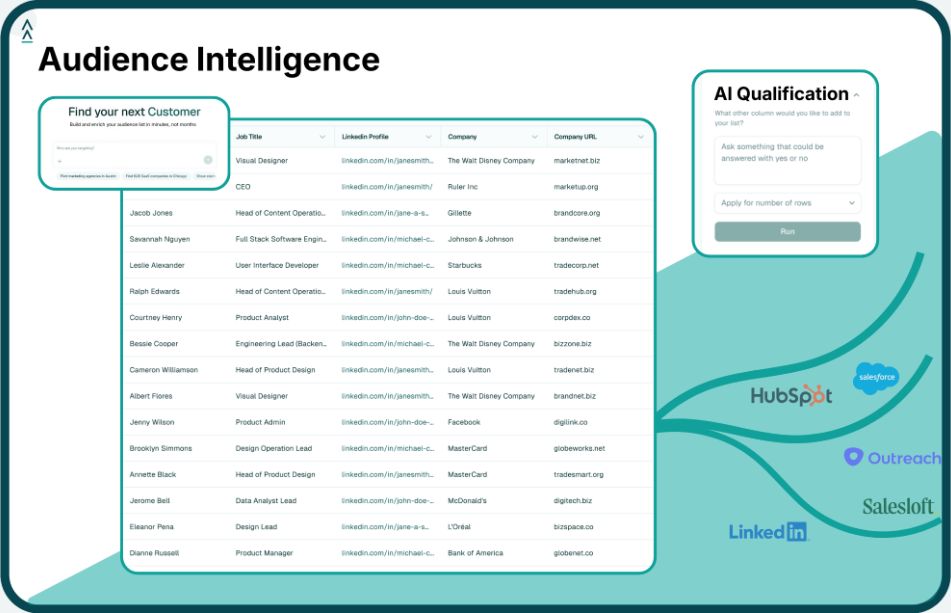
Within this ecosystem, AI-powered go-to-market automation becomes critical for companies selling to these specialized verticals. Understanding the specific needs of healthcare, legal, or developer audiences requires more than basic firmographic data—it demands platforms that can interpret natural language and surface prospects based on real-time signals like funding rounds, hiring activity, and technology stack changes.
This list highlights companies that demonstrate exceptional growth velocity in the workflow automation space, prioritizing:
The ranking prioritizes growth velocity over absolute market share, reflecting the dynamic nature of the AI-powered automation market where newer entrants can achieve unprecedented adoption rates.
These workflow automation leaders show how critical specialization has become in the AI era. But to effectively reach these specialized audiences, go-to-market teams need equally sophisticated targeting capabilities. This is where platforms like VibeGTM become essential.
Instead of manually assembling lists or writing complex database queries, GTM teams can use natural language to find prospects in these high-growth verticals. For example:
Landbase's company data includes 300M+ contacts and 24M+ companies with 1,500+ unique signals spanning firmographic, technographic, intent, hiring, and funding data. This enables teams to:
For B2B organizations selling into the specialized workflow automation market, AI-powered GTM isn't just convenient—it's necessary for efficiently connecting with the right decision-makers at the right time.
Workflow automation eliminates repetitive manual tasks, reduces errors, and increases operational efficiency. Modern AI-powered platforms go beyond simple task automation to provide intelligent decision-making, predictive insights, and autonomous optimization. This leads to faster processes, reduced operational costs, improved employee satisfaction, and better customer experiences, with companies implementing intelligent automation seeing significant improvements in productivity and the ability to reallocate human resources to higher-value strategic work.
Traditional workflow automation tools connect apps and automate predefined processes based on rules and triggers. Agentic AI like GTM-2 Omni interprets natural language, understands business context, and autonomously discovers and qualifies prospects based on 1,500+ unique signals. Instead of following predefined rules, agentic AI learns from billions of go-to-market data points and sales conversations to make intelligent decisions about audience fit and timing. This delivers AI-qualified exports ready for immediate activation rather than requiring manual list building and qualification.
When choosing workflow automation software, startups should consider specialization versus generalization, as vertical-specific tools often provide better functionality than horizontal platforms. Modern platforms should leverage AI for intelligent automation rather than just rule-based workflows. Integration requirements must ensure compatibility with your existing tech stack, while scalability means the solution should grow with the business. Finally, ease of use is critical—non-technical team members should be able to configure and manage automations without developer support.
Healthcare, legal, and developer productivity are experiencing the most significant impact from specialized workflow automation technologies. In healthcare, platforms like Abridge and Hippocratic AI are addressing critical physician burnout and workforce shortages. In legal, Harvey is transforming how law firms conduct research and draft documents. In developer productivity, Cursor is revolutionizing how software engineers write code. These vertical-specific solutions are achieving faster growth than horizontal tools by solving industry-specific pain points with deep domain expertise.
CEOs play a critical role in shaping workflow automation companies by establishing strategic vision, securing funding, and building strong teams. Leaders like Bret Taylor at Sierra bring seasoned enterprise experience that accelerates enterprise adoption. CEOs also influence company culture and priorities, with successful workflow automation companies focusing on solving specific industry pain points rather than building general-purpose platforms. The fastest-growing companies demonstrate that CEO leadership in identifying market opportunities and executing on specialized solutions directly correlates with exceptional valuation growth and market penetration.
Tool and strategies modern teams need to help their companies grow.