.png)
.png)

Daniel Saks
Chief Executive Officer


The warehouse automation market is exploding—projected to reach $105.45 billion by 2035 from $21.23 billion in 2024, a 15.69% CAGR. Labor shortages (2.1M unfilled warehouse jobs by 2030), e-commerce growth, and AI adoption are forcing warehouses to automate or fall behind. For go-to-market teams in the automation space, identifying decision-makers at companies investing in these technologies is critical. Agentic AI platforms like Landbase now enable teams to find these prospects instantly using natural-language prompts like "Manufacturing companies expanding into new regions with recent funding."
Symbotic provides end-to-end AI-powered robotic warehouse automation with autonomous mobile robots (SymBots) for case handling. The company designs, builds, and operates complete systems, orchestrating fleets of robots in high-density storage environments. Their modular, scalable case-handling system automates pallet breakdown and assembly.
Symbotic holds the highest market valuation at $31.3 billion market cap (July 2025), making it the most valuable pure-play warehouse automation company. The company has proven enterprise scale with 42+ Walmart distribution centers deployed, representing the largest warehouse automation deployment globally. Vertical integration with full control over hardware, software, and operations ensures system reliability and performance.
CEO: Richard B. Cohen (Founder)
President & COO: Wesley Randall
Founded: 2007
Publicly traded (NASDAQ: SYM) since 2022
$31.3 billion market cap as of July 2025
Dematic offers the most comprehensive warehouse automation portfolio, including AS/RS, shuttle systems, AGVs, conveyor/sortation, and the Dematic IQ software platform. As a subsidiary of KION Group, it provides end-to-end solutions from mini-load to mega-sites, serving as the world's largest warehouse automation provider.
Dematic is the world's largest warehouse automation provider with $2.5+ billion revenue (2024). As the only provider with a complete portfolio covering all warehouse functions, Dematic offers unmatched breadth. Global engineering centers in North America, Europe, and Asia-Pacific ensure local support worldwide.
CEO: Hasan Dandashly
Parent Company CEO: Gordon Riske (KION Group)
Founded: 1819 (as Atchison, Topeka and Santa Fe Railway department)
Subsidiary of KION Group (Frankfurt Stock Exchange)
KION Group: $7.9 billion cap
Daifuku provides comprehensive warehouse automation systems including AS/RS, AGVs, conveyor systems, and sorting systems. Founded in 1937, it's one of the oldest automation providers globally, with specialized expertise in cleanroom environments for semiconductor fabs and leading airport baggage handling systems.
Founded in 1937, Daifuku is one of the oldest and largest automation providers globally with ¥611.477B revenue (~$3.95 billion USD) in FY 2024. The company is the leading provider of cleanroom automation for semiconductor manufacturing and airport baggage systems. Global operations span 25+ countries with strong presence in automotive, electronics, and logistics.
President & CEO: Atsushi Saito
Chairman: Masahiro Saito
Founded: 1937
Publicly traded (Tokyo Stock Exchange: 6383)
¥570 billion revenue FY 2024
Locus Robotics provides collaborative autonomous mobile robots (AMRs) that work alongside warehouse workers to enhance productivity. Their Origin and Vector robot models are orchestrated by the LocusONE platform, enabling goods-to-person picking in existing warehouse environments without infrastructure changes.
Locus Robotics operates the largest AMR deployment with 6,000+ bots in production across 300+ facilities in 18 countries. The company delivers proven productivity gains of 2-3x improvements, 50% faster cycle times, with 6-8 month ROI. Industry-leading deployment speed of 4-6 weeks to go-live sets Locus apart from competitors.
CEO: Rick Faulk
Co-Founder & CTO: Bruce Welty
Founded: 2014
Series F led by Industrial Innovation Fund
Total funding: Over $1 billion (unicorn status achieved)
GreyOrange offers a fully integrated software and robotics platform with its GreyMatter AI orchestration system and Ranger AMRs. The company claims to use "fulfillment science" to optimize goods-to-person, zone transfer, and inventory movement across multi-category robotic systems.
As the highest-funded startup with $545 million funding, GreyOrange is the only company claiming complete integration of proprietary AI with multi-category robotic systems. The company's global footprint serves 2 billion+ warehouse units annually across 4 continents with a Tracxn Score: 74/100
Co-Founder & CEO: Samay Kohli
Co-Founder & President: Akash Gupta
Founded: 2011
Series D: December 21, 2023
Total Funding: $545 million
Key Investors: Mithril, Tiger Global, Blackstone (56 investors)
Mytra provides AI-powered 3D robotics for automated storage and retrieval (AS/RS) with a software-defined approach. Their modular system handles any pallet up to 1,360kg and emphasizes software control over traditional rigid infrastructure, addressing the acute labor shortage in warehousing.
Mytra secured the newest major funding with $120 million C announced January 15, 2026. The elite team includes 50+ members from Tesla, Rivian, and Google backgrounds. Mytra directly addresses the critical labor shortage targeting 2 million unfilled warehouse jobs forecast by 2030.
Co-Founder & CEO: Ahmad Baitalmal (former Tesla)
Co-Founder & CTO: Chris Walti (former Rivian)
Founded: 2022
Series C: $120 million (January 15, 2026)
Lead Investor: Avenir Growth
Other Investors: Greenoaks, Eclipse Ventures
Dexory provides a data intelligence platform using autonomous robots to create digital twins of warehouses through real-time scanning. Their DexoryView platform scans 10,000+ locations per hour using LiDAR-based 3D scanning, enabling real-time inventory reconciliation and warehouse optimization.
Dexory's data-first approach focuses on warehouse visibility and intelligence rather than just moving goods. The company secured massive European funding with €143 million C (October 2025), positioning it as Romania's second-largest Series C. Blue-chip customers include GXO, Maersk, DHL, Stellantis, and GE Appliances.
Co-Founder & CEO: Gabriel El-Saigh
Co-Founder & CTO: Ovidiu Bârlea
Founded: 2015
Series C: €143 million (October 2025)
Lead Investor: Eurazeo
Other Investors: LTS Growth, DTCP, Atomico
Exotec provides agile, lightweight Skypod robots for goods-to-person AS/RS systems. Their modular approach enables rapid deployment without the single points of failure common in traditional AS/RS systems. The company recently launched its Next-Gen Skypod system in February 2025 based on extensive customer feedback.
Exotec achieved unicorn status ($1 billion+ valuation) as a French robotics company. The agile, modular system implements quickly versus traditional AS/RS. Customer-driven innovation led to the Next-Gen Skypod (February 2026) addressing persistent warehouse difficulties.
Co-Founder & CEO: Romain Moulin
Co-Founder & CTO: Renaud Delaunay
Founded: 2015
Unicorn status achieved
Over $335 million total funding
Agility Robotics develops Digit, the only bipedal humanoid robot in logistics that can walk, climb stairs, and manipulate objects with arms. Designed to navigate existing warehouse infrastructure without redesign, Digit addresses environments not built for traditional robotics.
Agility Robotics has created the only bipedal humanoid in logistics as Digit robot walks, climbs stairs, and manipulates objects. The existing infrastructure-friendly design requires no warehouse redesign, unlike traditional automation. Advanced mobility through two-legged locomotion enables operation in unstructured environments.
Co-Founder & CEO: Damion Shelton
Co-Founder & CTO: Jonathan Hurst
Founded: 2015
Series B: $180 million
Key Investors: Playground Global, DCVC (16 investors)
Geek+ provides AMR solutions including Shelf-to-Person, PopPick, and MovePick systems, orchestrated by their CarouselAI platform. They serve global clients including UPS with 24/7 operations at their huge facilities.
Geek+ became the first AMR IPO globally, listed on Hong Kong Stock Exchange in July 2025. Market leadership includes #1 in order fulfillment and #1 in mobile robots globally for 7 consecutive years. Proven scale with 10,000+ robots deployed worldwide serving 100+ global clients.
Co-Founder & CEO: Yong Zheng
Co-Founder & CTO: Gary Wang
Founded: 2015
IPO: Hong Kong Stock Exchange
133.62x oversubscribed
Addverb provides a full suite of warehouse automation solutions including AMRs, AS/RS, WMS, and sortation systems. As India's largest warehouse automation provider, it was acquired by Reliance Industries/Retail, giving it significant backing for expansion across Asia.
Addverb is India's market leader as the largest warehouse automation provider in India. Reliance backing through acquisition by Reliance Industries/Retail provides significant capital and customer access. Full solution portfolio offers comprehensive capabilities from AMRs to WMS and sortation.
Co-Founder & CEO: Sangeet Kumar
Co-Founder & CTO: Aditya Varma
Founded: 2016
Total Funding: $66.9 million
Acquisition: Reliance Industries/Retail
Ati Motors provides safety-certified autonomous mobile robots for indoor/outdoor operation, including tugging, lifting, and pallet moving capabilities. Their AMRs integrate with existing infrastructure without requiring changes, making them suitable for environments with mixed human-robot operations.
Ati Motors offers safety-certified AMRs suitable for mixed human-robot environments. Infrastructure integration works with existing warehouse infrastructure without modifications. Indoor/outdoor capability provides versatile robots that operate across different environments.
Co-Founder & CEO: Saurabh Chandra
Co-Founder & CTO: Rahul Singh
Founded: 2017
Series B: $20 million in Series B
Fabric provides micro-fulfillment centers with tri-temperature automation (ambient/chilled/frozen) specifically designed for grocery retail. Their modular 4K-50K sq ft configurations enable same-day delivery with profitable unit economics, addressing the unique challenges of food and beverage logistics.
Fabric is a grocery retail specialist designed specifically for food and beverage logistics challenges. Tri-temperature capability uniquely handles ambient, chilled, and frozen goods in the same facility. Profitable unit economics enable same-day delivery with positive ROI for retailers.
Co-Founder & CEO: Elram Gruper
Co-Founder & CTO: Avner Levari
Founded: 2015
Series C: $200 million valuation
Focus: Grocery micro-fulfillment
Warehouse automation has become essential as e-commerce demands faster fulfillment, labor shortages persist, and AI capabilities mature. The market's projected growth from $21.23 billion to $105.45 billion reflects fundamental shifts in supply chain expectations. Companies are no longer choosing between automation or manual operations—they must automate to remain competitive.
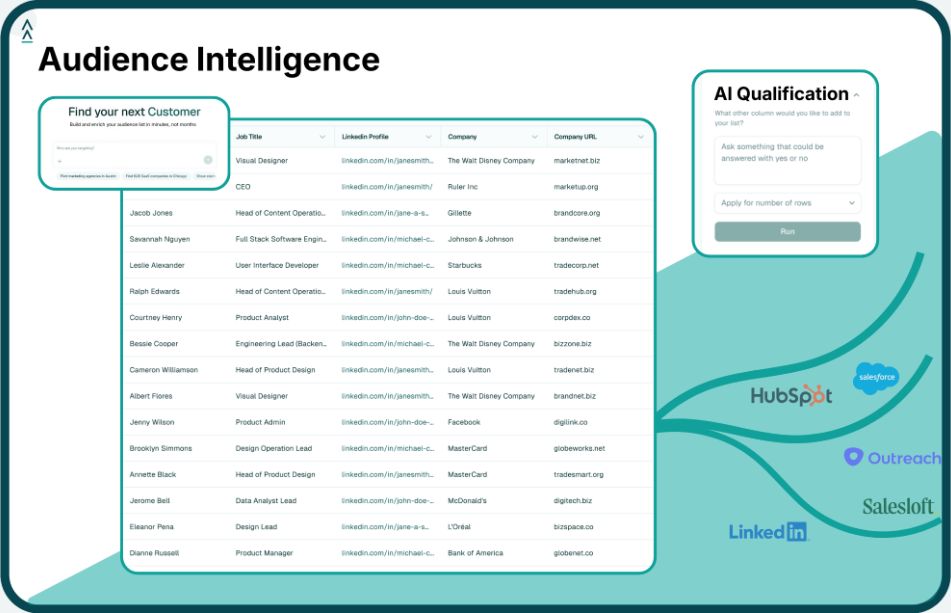
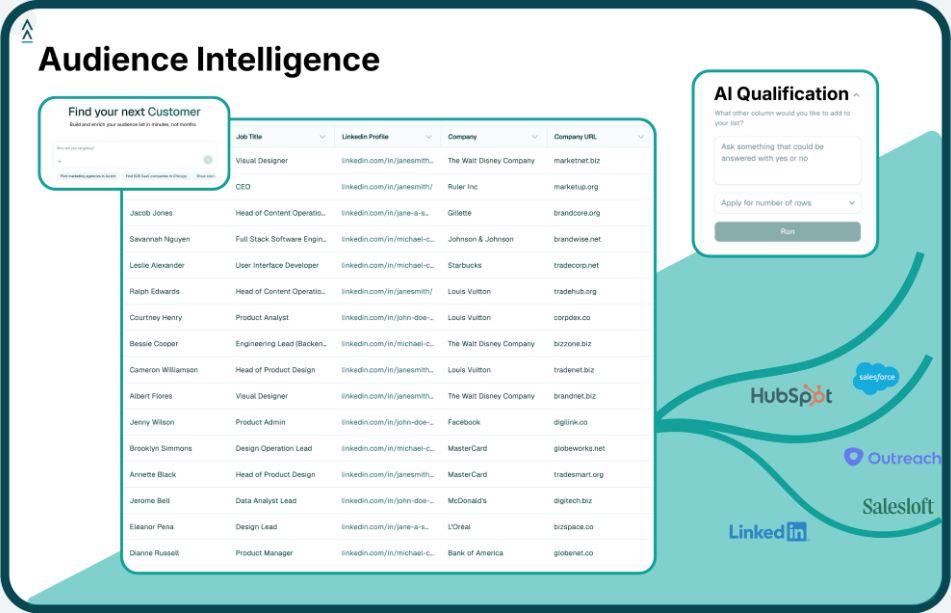
Within this ecosystem, identifying the right prospects for automation solutions requires sophisticated targeting. Platforms like Landbase Intelligence provide growth signals including recent funding, manufacturing expansion, and technology stack changes that indicate buying readiness.
This list highlights established leaders and fast-growing startups that:
These warehouse automation leaders show how critical timing and targeting are for B2B sales. Companies don't buy automation randomly—they invest when expanding facilities, experiencing labor shortages, or modernizing operations.
This is where natural-language targeting becomes essential. Instead of manually filtering databases, automation vendors can use prompts like:
Landbase's platform combines 300 million+ contacts with 1,500+ unique signals across firmographic, technographic, intent, hiring, and funding data. By leveraging AI qualification, teams can identify high-intent prospects and export up to 10,000 contacts instantly for immediate activation.
For warehouse automation companies competing in a rapidly growing market, AI-powered GTM isn't optional—it's the key to efficient prospecting and accelerated revenue growth.
Warehouse automation provides significant benefits including 65% labor cost reduction, 2-3x productivity gains, and 99% inventory accuracy. Automation enables faster order fulfillment, reduces picking and packing errors, and improves workplace safety by handling repetitive or dangerous tasks. Most companies achieve ROI within 6-24 months of deployment. The technology also helps address the critical labor shortage with 2.1M unfilled warehouse jobs projected by 2030.
AI enhances warehouse automation by orchestrating robot fleets, optimizing picking routes, predicting maintenance needs, and enabling real-time decision-making. Companies like Symbotic with their $31.3B platform and GreyOrange use "fulfillment science" AI to coordinate multi-category robotic systems for maximum efficiency. AI-powered platforms can analyze millions of data points to optimize warehouse layouts, predict demand patterns, and dynamically adjust robot assignments. This orchestration layer has become the key differentiator in modern warehouse automation beyond just moving goods.
Common warehouse robots include Autonomous Mobile Robots (AMRs) like Locus Robotics' 6,000+ deployed bots for collaborative goods-to-person picking. Automated Storage and Retrieval Systems (AS/RS) like Symbotic and AutoStore provide high-density storage solutions. Specialized robots include Agility Robotics' bipedal Digit for navigating existing infrastructure and Dexory's autonomous data-scanning robots. AMRs typically handle goods-to-person picking and zone transfers, while AS/RS systems manage vertical storage optimization in limited footprints.
While not traditional warehouse robotics companies, UiPath (RPA), AirSlate (document automation), and WorkFusion (intelligent automation) handle the administrative and data processing aspects of warehouse operations. They automate invoice processing, shipment documentation, compliance reporting, and other back-office functions that support physical automation. These platforms integrate with warehouse management systems (WMS) to streamline order processing, inventory reconciliation, and customer communications. By automating administrative tasks, they free up human workers to focus on higher-value activities alongside physical automation robots.
Key considerations include deployment speed like Locus Robotics' 4-6 week implementation, ROI timeline (typically 6-24 months), and integration with existing infrastructure. Companies should evaluate whether solutions require warehouse redesign or can work with existing layouts, which significantly impacts total cost. Scalability for future growth, vendor financial stability, and ongoing support capabilities are critical factors. Additionally, consider the automation type—collaborative AMRs versus fixed infrastructure—and whether the solution addresses your specific pain points like labor shortages, order accuracy, or fulfillment speed.
Tool and strategies modern teams need to help their companies grow.