.png)
.png)

Daniel Saks
Chief Executive Officer


The open banking revolution is accelerating at unprecedented speed. Open banking API calls are projected to surge from 137 billion in 2024 to 722 billion by 2028—a 427% explosion driving the financial data revolution across global markets. As traditional banks and fintech companies race to enable secure financial data sharing, a new infrastructure layer is emerging. These are the platforms powering the open banking market, valued at $35.30 billion in 2025 and projected to reach $190.94 billion by 2034. For go-to-market teams targeting this high-growth sector, identifying the right decision-makers at these rapidly scaling companies is critical. Agentic AI platforms like Landbase now sit alongside these open banking leaders, transforming how B2B teams find and engage their ideal customers through natural-language targeting and AI-qualified audience discovery.
Plaid provides the critical infrastructure connecting traditional financial institutions with the fintech ecosystem through secure, standardized APIs. The platform enables seamless account connectivity, authentication, identity verification, and payment initiation for thousands of digital finance applications. Plaid's developer-first approach has made it the backbone of the open banking movement in the Americas.
Plaid powers connections for major fintech apps including Venmo and SoFi, providing bank-grade security and compliance for financial data access. The identity verification product saw 400% usage growth while the Payments product experienced 3x usage increase. At least half of Americans have used Plaid services. Revenue was up over 25% year-over-year.
Leadership:
Recent Funding:
Stripe has become the de facto payment infrastructure for the internet, processing transactions equivalent to 1.3% of global GDP. The company's API-first approach and Stripe Connect open banking capabilities enable businesses to launch and scale online commerce without building complex payment systems from scratch. Stripe's platform serves half of Fortune 100 companies and powers payments across 120+ countries.
Stripe processes payment volume equivalent to 1.3% of global GDP, achieved profitability in 2024, and is used by half of Fortune 100 companies. Stripe Connect enables operations across 35+ markets with 14 languages. The company maintains a 77% AI Visibility Score, appearing in 3 of 4 AI-generated answers about payment processing.
Leadership:
Recent Funding:
Tink provides comprehensive European open banking coverage through a single API that connects to 3,400+ banks and financial institutions across Europe. The platform combines payments, data access, and transaction enrichment in a unified offering, enabling businesses to develop data-driven financial products and improve lending processes. As a Visa solution, Tink benefits from global network resources and regulatory expertise.
Tink's single API connects to 3,400+ European banks, combining payments, data access, and enrichment in a unified offering. Following its $2.2 billion acquisition by Visa, Tink benefits from global network resources. The platform was named a leader by Forrester and works with major institutions including Revolut, Adyen, BNP Paribas, HSBC, and Nuvei.
TrueLayer leads the European account-to-account (A2A) payment infrastructure, connecting to 80% of bank accounts across 20 European markets through a single API. The platform handles almost half of all UK Pay by Bank payments with 95%+ success rates, enabling cost-effective, fraud-resistant payment solutions for e-commerce and financial services.
TrueLayer handles almost half of UK Pay by Bank payments with 95%+ average success rates in top markets, driving merchant adoption. The platform enables 40%+ lower payment costs versus cards with no scheme/interchange fees. Clients report a 20% increase in average order value, and the network processes more than 2x the daily volume of nearest competitors.
Yodlee provides enterprise-scale data aggregation and analytics with a 25-year legacy, serving 601M+ connected consumer accounts through 19,000+ data sources. The platform leverages over 91% direct API connections (vs. screen scraping) to deliver personal financial management, credit solutions with alternative data, and wealth management tools to 1,500+ financial institutions and fintechs.
With a 25-year legacy and 601M+ connected accounts, Yodlee serves 15 of top 20 US banks. The platform achieves over 91% direct API connections versus screen scraping, ensuring superior data quality. As part of Mastercard, Yodlee benefits from global infrastructure and compliance capabilities while serving 30 million end users.
Yapily provides open banking infrastructure across 19 countries, connecting to 2,000+ banks and institutions through a comprehensive product suite that includes payment initiation, financial data access, and data enrichment. The platform has been chosen by Google to support bank account verification service rollout and powers 3,500+ customer applications.
Yapily was chosen by Google to support bank account verification service rollout, demonstrating enterprise trust. The platform offers a comprehensive product suite combining payments, data access, and enrichment, and leads innovation in Variable Recurring Payments (VRP) and commercial VRP capabilities. Yapily powers 3,500+ applications created by customers and maintains strong UK and German market penetration.
Salt Edge provides a universal open banking and open finance platform with global reach across 50+ countries, connecting to 5,000+ financial institutions. The platform serves 300+ companies across multiple verticals including lending, banking, e-commerce, treasury, automotive, and iGaming, offering data aggregation, Pay by Bank, and machine learning-powered data enrichment.
Salt Edge connects to 5,000+ banks across 50+ countries, providing broader geographic coverage than regional competitors. Clients can use Salt Edge's PSD2 license without needing their own, reducing compliance burden. The platform is ISO 27001-certified and PSD2-licensed, serving 6+ major use cases from lending to iGaming with almost a decade of expertise.
Finicity, as Mastercard's open banking arm, provides secure payments and data connections between people and businesses, enabling account-to-account payments, streamlined onboarding, personal financial management, business cashflow visibility, and smarter lending decisions. The platform covers 95% of U.S. deposit accounts and processes 15B+ API calls globally each year.
Finicity benefits from 60+ years of payments expertise and Mastercard's global network, covering 95% of U.S. deposit accounts. The platform processes 15B+ API calls annually, demonstrating massive enterprise scale. As part of Mastercard's open finance strategy, Finicity helped Saxo Bank achieve a 26% increase in funding conversion rate after implementation.
MX Technologies helps companies do more with financial data that empowers consumers to reach their financial goals. The platform powers actionable financial data intelligence to increase engagement and loyalty, acquire more customers, and identify growth opportunities through secure connectivity, enhanced data, and embedded experiences. MX processes over 170 billion transactions with 95% categorization coverage.
MX turns raw financial data into actionable insights with context, processing 150M+ transactions per day that demonstrates massive scale. The platform enables financial institutions to build personalized UIs and is an active participant in open banking policy discussions. With 13,000+ connections across financial institutions and fintechs, MX maintains 95% category coverage across its platform.
Token.io provides leading account-to-account payment infrastructure across 21 countries with 90%+ bank account connectivity in most markets. The platform powers HSBC Open Payments, Santander instant payments, and BNP Paribas Instanea, enabling low-cost, real-time bank payments with high success rates and instant settlement for major financial institutions.
Token.io powers payment infrastructure for HSBC, Santander, BNP Paribas, achieving 95%+ payment success rates with continuous improvement focus. The company won multiple 2025 industry awards including Juniper Research Platinum Winner, and provides access to 567 million verified accounts in UK and Europe. Partner Computop processes $30B annually through its Paygate platform.
The open banking ecosystem represents a fundamental shift in how financial data flows between institutions, businesses, and consumers. Instead of siloed banking systems, open banking creates a connected financial data layer that enables innovation across lending, payments, personal finance, and embedded finance. This infrastructure layer is critical because it:
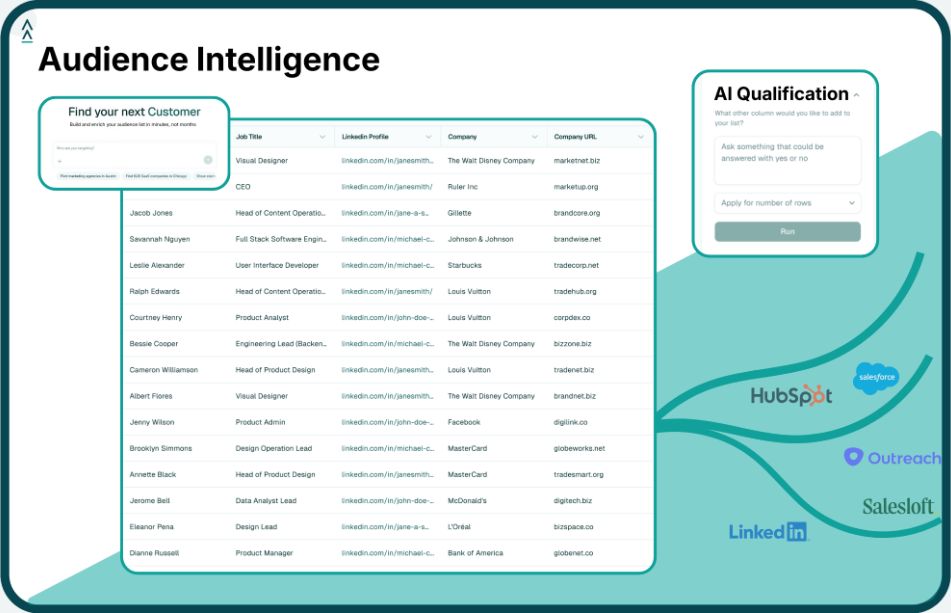
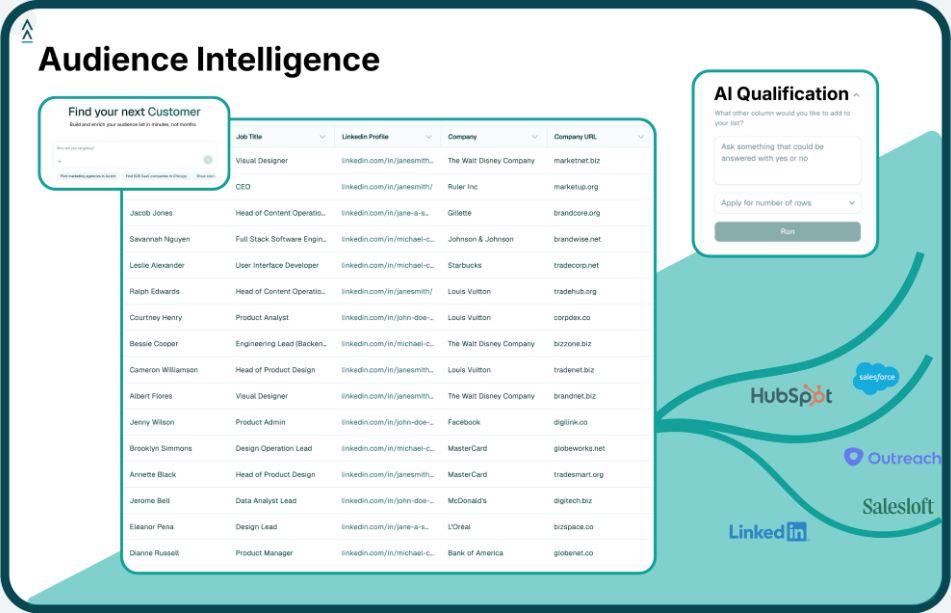
Within this ecosystem, platforms like Landbase help B2B companies target these rapidly growing open banking companies through natural-language audience discovery. Rather than manually researching which open banking companies raised funding or expanded into new markets, GTM teams can use agentic AI to find prospects based on real-time signals.
This list highlights platforms that demonstrate exceptional growth, market reach, and strategic importance in the open banking ecosystem:
The open banking companies on this list represent ideal prospects for B2B SaaS vendors, particularly those offering infrastructure, compliance, security, or developer tools. These companies share common characteristics that make them attractive targets:
This is where platforms like Landbase's VibeGTM interface become essential. Instead of manually identifying which open banking companies fit your ideal customer profile, you can use natural-language prompts like: "Open banking fintech companies that raised Series B+ funding in the last 12 months with engineering teams of 100+." Landbase's GTM-2 Omni model then interprets this query and returns AI-qualified audiences ready for immediate activation.
An Open Banking fintech provides the infrastructure layer that enables secure, consent-based sharing of financial data between banks, third-party providers, and consumers. These companies are growing rapidly due to regulatory tailwinds like PSD2 in Europe and Section 1033 rulemaking in the US, combined with consumer demand for better financial experiences. The market, valued at $35.30 billion in 2023, is projected to grow to $190.94 billion by 2032, driven by increasing adoption of account-to-account payments and data-driven financial services. Open banking API calls alone are projected to surge from 137 billion in 2024 to 722 billion by 2028—a 427% increase.
Open Banking transforms traditional banks from closed systems to open platforms that can generate new revenue streams through API monetization. Rather than viewing fintech companies as competitors, many banks are partnering with open banking platforms to enhance their offerings. For example, JPMorgan Chase strengthened its decades-long partnership with Yodlee, while HSBC, Santander, and BNP Paribas use Token.io for their payment infrastructure. This shift enables banks to focus on their core competencies while leveraging specialized fintech infrastructure for innovation. Traditional banks also benefit from reduced fraud through bank-grade authentication and real-time payment verification.
Open Banking fintechs attract significant venture capital investment and strategic acquisitions from major payment networks. Recent examples include Plaid's $425M Series D in April 2021 at a $13.4 billion valuation and Stripe's $6.5B Series I in March 2023. Major payment networks like Visa and Mastercard have made strategic acquisitions, with Visa purchasing Tink for $2.2 billion and Mastercard acquiring both Yodlee and Finicity. This funding reflects investor confidence in the long-term strategic importance of open banking infrastructure as the market grows from $35.30 billion in 2023 toward $190.94 billion by 2032.
B2B companies can effectively target Open Banking fintech companies by leveraging AI-powered audience discovery platforms that combine natural-language targeting with real-time signals. Instead of manually researching which companies fit your ideal customer profile, you can use prompts like "Open banking companies with 100+ employees that use AWS and raised funding in the last 18 months." Platforms like Landbase provide access to 300M+ contacts and 24M+ companies with 1,500+ unique signals, enabling precise targeting based on funding rounds, hiring activity, tech stack changes, and other growth indicators.
Tool and strategies modern teams need to help their companies grow.