.png)
.png)

Daniel Saks
Chief Executive Officer


The no-code revolution has transformed software development, creating over $50 billion in company value in just five years. By 2026, the no-code market is projected to reach $21.2 billion, with forecasts suggesting it could explode to $187 billion by 2030. From bootstrapped unicorns to $11 billion enterprise giants, these 11 fastest-growing companies are democratizing app development for millions of non-technical founders and business teams. For go-to-market professionals, understanding these platforms is essential—many integrate seamlessly with Landbase's agentic AI to enhance audience discovery and qualification capabilities.
Bubble is the most comprehensive no-code platform for building complex web applications without writing code. The platform enables users to create everything from SaaS products to marketplaces with extensive customization capabilities. In 2025, Bubble launched native mobile building, allowing developers to create iOS and Android apps from the same codebase.
Bubble pioneered the comprehensive no-code platform approach with the largest plugin ecosystem featuring 8,000+ plugins providing pre-built functionality for any use case. The platform's AI-powered generation can create entire apps and pages from text prompts, while serving as the foundation for many other no-code businesses. Market validation includes 5 million+ builders and $100 million Series A funding from Insight Partners.
OutSystems is an enterprise-grade low-code platform designed for building mission-critical applications at scale. The platform serves Fortune 500 companies requiring robust security, governance, and integration capabilities. In 2025, OutSystems launched its Agent Workbench, enabling custom AI agent creation and orchestration.
OutSystems established enterprise low-code credibility as a Gartner Magic Quadrant Leader for nine consecutive years with 20+ years serving Fortune 500 companies. The platform provides full DevOps integration with enterprise governance, deployment pipelines, and monitoring, achieving 10x faster development than traditional coding approaches. Market recognition includes $9.5 billion valuation and 1,500+ enterprise customers.
Airtable pioneered the "collaborative database" approach, combining spreadsheet interfaces with relational database capabilities. The platform evolved from a simple database tool to a full application development platform with Airtable Interfaces, allowing users to build customer portals, dashboards, and internal tools.
Airtable created an entire ecosystem of frontend builders (Softr, Stacker, Pory) that use Airtable as their backend, establishing the database-first approach for structured data management. The platform's extensive integrations with hundreds of third-party connections and AI-native features integrated directly into database operations serve 300,000+ organizations globally. Market validation includes $11 billion valuation and $735 million Series F funding.
What They Do:
Zapier began as an automation platform connecting apps and services but evolved into a comprehensive no-code application development suite. The platform now includes Interfaces, Tables, Forms, and AI Agents, allowing users to build complete applications without coding while maintaining its core workflow automation capabilities.
Why They're Important:
Zapier represents the ultimate bootstrap success story, achieving $5 billion valuation on just $1.4 million funding with $140 million ARR by 2020. The platform features 8,000+ app integrations—the largest integration network in no-code—and evolved from pure automation to a full app building suite with AI Agents and Chatbots. 2.2 million+ businesses now rely on Zapier automation.
Mendix is an enterprise low-code platform specializing in industrial IoT applications and manufacturing use cases. Acquired by Siemens in 2018 for $730 million, the platform features deep integration into Siemens' Xcelerator ecosystem. Mendix 11, released in 2025, features advanced agentic AI capabilities through its MAIA AI Assistant.
Mendix established enterprise low-code leadership as a Gartner Magic Quadrant Leader for nine consecutive years with the highest rating for "Completeness of Vision" in 2025. The platform's deep integration with Siemens Xcelerator for industrial IoT and manufacturing ecosystems, combined with MAIA AI Assistant for AI-powered development throughout the software development lifecycle, serves Fortune 500s including Cengage, Merck, and KLM.
Webflow is a visual web development platform bridging design tools and code. The platform offers professional-grade visual design tools rivaling Adobe desktop software while generating clean, semantic HTML, CSS, and JavaScript. Webflow includes built-in CMS and e-commerce capabilities for complete responsive websites and web applications.
Webflow pioneered designer-focused no-code development with professional-grade visual design tools and clean code export generating semantic HTML, CSS, and JavaScript. The platform's built-in CMS and e-commerce functionality, combined with a strong agency ecosystem and robust partner network, serves 3.5 million+ users globally including Dell, Upwork, and IDEO. Market validation includes $4+ billion valuation and $120 million Series B funding.
Glide transforms spreadsheets into powerful business applications in minutes. The platform connects to Google Sheets, Excel, Airtable, and SQL databases to create functional apps without coding. Glide apps are "beautiful by default" and include built-in AI capabilities for text generation, image-to-text conversion, and audio transcription.
Glide pioneered instant spreadsheet-to-app transformation with "beautiful by default" apps requiring no design effort while providing built-in AI actions for text generation, image-to-text, and audio transcription. Enterprise-grade security includes SOC 2 Type 2 compliance, SSO, and advanced permissions. Customer success metrics include Lonestar Communications achieving 15x field technician efficiency and yetipay seeing 750% revenue growth across 100,000+ companies.
Retool specializes in building internal tools, admin panels, dashboards, and CRUD applications for businesses with technical resources. The platform is developer-friendly, supporting JavaScript, SQL queries, and custom components while maintaining a no-code/low-code interface with native connectors for 50+ databases and APIs.
Retool established the internal tools category with purpose-built capabilities for admin panels, dashboards, and CRUD apps featuring developer-friendly JavaScript support, SQL queries, and custom components. Enterprise data connectivity with native connectors for 50+ databases and APIs, plus self-hosting for compliance-sensitive industries, serves 10,000+ companies including DoorDash, Peloton, Brex, and Coinbase. Market validation includes $3.2 billion valuation.
FlutterFlow is a low-code platform for building native mobile and web applications using Google's Flutter framework. The platform's key differentiator is full Flutter code export, eliminating vendor lock-in concerns. Users can export production-ready Flutter/Dart code and deploy to iOS, Android, web, and desktop.
FlutterFlow pioneered low-code Flutter development with complete code ownership through export of production-ready Flutter/Dart code, creating true native apps that compile to native iOS, Android, web, and desktop. GitHub integration for version control and backing from Google Ventures validates the approach. Growth metrics include 2 million+ users in 4 years serving Atlassian, Google, and Wendy's, with customers reporting "10X velocity".
Adalo is a mobile-first no-code platform creating genuinely native iOS and Android apps publishable to App Store and Google Play Store. The platform offers responsive apps that work as native mobile, web apps, and PWAs simultaneously. Adalo is launching an AI Builder in early 2026 and recently completed a 3.0 backend overhaul.
Adalo pioneered true native mobile app creation as the only no-code platform creating genuinely native iOS/Android apps publishable to App Store/Play Store, with responsive apps working as native mobile, web app, and PWA simultaneously. The 3-4x infrastructure performance boost from Version 3.0 backend overhaul supports 1 million+ apps, 2 million+ end users, 99% uptime, and 20 million+ daily data requests. The upcoming AI Builder launches early 2026.
Microsoft Power Apps is part of the Microsoft Power Platform and integrates deeply with Microsoft 365, Azure, and Dynamics 365. The platform enables organizations in the Microsoft ecosystem to build custom applications without extensive coding, leveraging Microsoft's enterprise distribution as the default choice for many organizations.
Microsoft Power Apps leverages Microsoft's global enterprise footprint with native integration to Microsoft 365, Teams, SharePoint, and Dynamics 365, providing pre-built templates for common business scenarios. Enterprise compliance built-in via Azure (GDPR, HIPAA, SOC 2) and Dataverse integration for Microsoft's proprietary business database serve millions of users through Microsoft 365 integration. Pricing starts at $5/user/month (per-app) and $20/user/month (unlimited).
The no-code movement has fundamentally changed how software gets built. Instead of requiring specialized coding skills, these platforms empower "citizen developers"—business users, marketers, sales professionals, and operations teams—to create applications solving specific problems. This democratization of development has accelerated innovation across industries, with 70% of new enterprise applications expected to use low-code/no-code by 2025.
The fastest-growing no-code platforms share several characteristics: AI integration for generation, automation, and intelligence; enterprise readiness with security, compliance, and governance features; ecosystem approach with extensive integrations and marketplaces; code ownership options to avoid vendor lock-in; and vertical specialization focusing on specific use cases. For go-to-market teams, these platforms offer powerful opportunities to build custom applications integrating with Landbase's audience intelligence.
This list highlights companies demonstrating exceptional growth across multiple dimensions: funding and valuation metrics showing significant recent rounds or high valuations; user growth rates with rapid adoption (Softr's 5x growth, FlutterFlow's 2M users); enterprise validation through Fortune 500 adoption and industry analyst recognition; innovation in AI with platforms leading AI integration; ecosystem strength with robust marketplaces and integrations; and strategic importance as infrastructure for the broader no-code movement.
As no-code platforms continue evolving, their integration with AI-powered go-to-market solutions becomes increasingly important. Platforms like Landbase's VibeGTM interface complement no-code development by providing the audience intelligence layer powering effective B2B outreach.
By combining no-code application development with AI-qualified audience data, businesses can build custom GTM applications leveraging real-time intent signals, create personalized outreach at scale using firmographic data, integrate audience intelligence directly into operational workflows, and reduce manual list building to focus on high-value engagement.
The 15 companies on this list represent the vanguard of the no-code movement, each contributing to a future where anyone can build software regardless of technical background. As these platforms continue growing and evolving, their integration with AI-powered solutions like Landbase will create even more powerful capabilities for modern business teams.
Many no-code platforms integrate with Landbase's audience intelligence through APIs or native integrations, allowing teams to build applications leveraging Landbase's 1,500+ unique signals across firmographic, technographic, intent, hiring, and funding data. For example, a no-code CRM built on Bubble could pull in AI-qualified prospect lists from Landbase, while a Retool dashboard could display real-time audience insights for sales teams. This combination creates powerful end-to-end solutions merging custom applications with sophisticated GTM capabilities without requiring extensive development resources.
AI has become table stakes for modern no-code platforms, with most leading solutions now including AI capabilities for app generation like Softr's AI Builder and Bubble's AI assistant, workflow automation through Zapier's AI Agents, and intelligent features such as Glide's built-in AI actions. The emergence of AI-native platforms like Momen specifically addresses growing demand for AI-powered applications. Industry analysis projects 30.2% CAGR for no-code AI platforms through 2033, reflecting the fundamental shift toward AI-enhanced development across the entire no-code ecosystem.
Several no-code platforms are specifically designed for enterprise-scale applications with proven track records serving Fortune 500 companies. OutSystems and Mendix have been Gartner Magic Quadrant Leaders for nine consecutive years, while Retool powers internal tools for companies like DoorDash and Coinbase. Xano provides HIPAA-compliant backend infrastructure for healthcare applications with 99.9% uptime guarantees. These platforms offer enterprise-grade security, compliance certifications (GDPR, HIPAA, SOC 2), governance features, and proven scalability for mission-critical applications.
Code ownership has become increasingly important as users seek to avoid vendor lock-in and maintain flexibility for future migration or extension needs. Platforms like FlutterFlow (Flutter/Dart export), WeWeb (Vue.js export), and Natively (React Native export) directly address this concern by allowing users to download and own their source code. This trend reflects the maturation of the no-code market where users expect both ease of use during development and the flexibility to take their applications elsewhere if needed, creating a balance between platform convenience and long-term control.
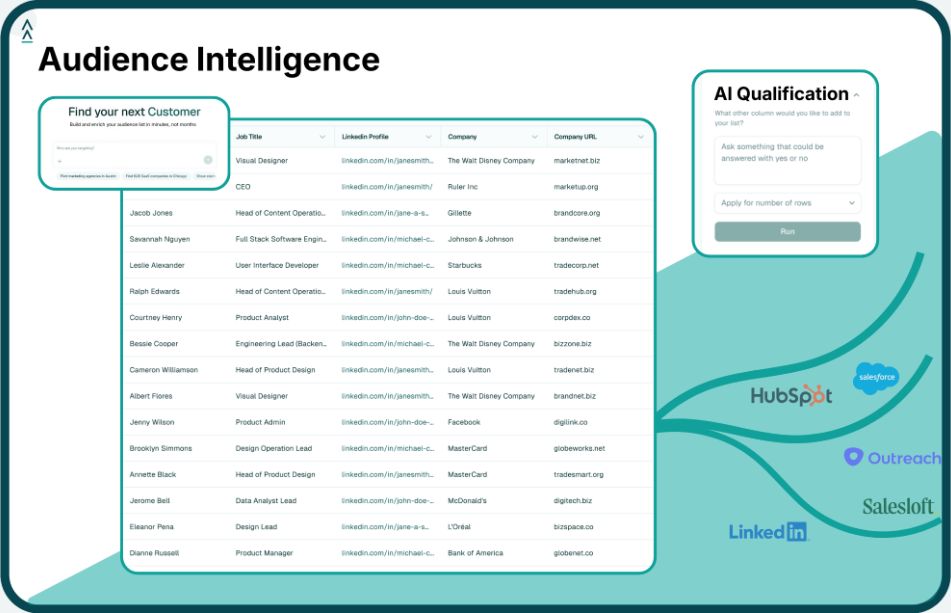
Landbase can identify companies using specific no-code platforms through its comprehensive tech stack detection capabilities tracking thousands of technology signals across 20 technology categories including development tools and platforms. Users can create targeted audience lists using natural-language prompts like "Marketing Directors at companies using Bubble or Webflow" or "CTOs at enterprises evaluating no-code platforms." This enables highly relevant outreach to prospects already invested in the no-code ecosystem, allowing sales teams to tailor messaging based on specific platform usage and development strategies.
Tool and strategies modern teams need to help their companies grow.