.png)
.png)

Daniel Saks
Chief Executive Officer


The low-code development platform market is experiencing explosive growth, projected to grow from $48.91 billion in 2026 to $376.92 billion by 2034 with a compound annual growth rate of 29.10%. As organizations race to digitally transform without expanding developer headcount, these platforms have become essential infrastructure. However, building innovative solutions is only half the battle—go-to-market teams still need to find and engage the right buyers efficiently. This is where AI-powered audience discovery platforms like Landbase complement the low-code ecosystem, helping teams identify high-value prospects who can benefit from these rapid development solutions.
Creatio delivers an enterprise low-code platform that uniquely combines customer relationship management (CRM) with business process management (BPM) in a single environment. The platform enables organizations to build custom applications with AI/ML modules for predictions and automation, supported by industry-specific templates for rapid deployment.
Creatio achieved unicorn status in 2024 with a $1.2 billion valuation, positioning it among the most valuable independent low-code companies globally. The platform serves thousands of customers across 100 countries with dual headquarters in Boston and Kyiv, demonstrating strong international market penetration. Gartner has recognized Creatio as a leader in its evaluations for low-code platforms, validating the company's technical capabilities and market position. The company's unique combination of CRM and BPM in a single low-code environment differentiates it from competitors focused on either application development or process automation alone.
OutSystems offers a full-stack enterprise low-code platform created in 2001, making it the first of its kind in the industry. The platform provides responsive UI development, built-in AI capabilities, one-click deployment, and enterprise-grade scalability with 150+ connectors for integration across cloud and on-premise environments.
OutSystems pioneered the enterprise low-code platform category in 2001, establishing the blueprint that many competitors have followed. The company maintains a valuation over $9.5 billion, making it one of the most valuable pure-play low-code companies globally. Gartner has consistently ranked OutSystems as a Leader in its Magic Quadrant for 2024-2025, recognizing both technical excellence and market execution. The platform's multi-cloud deployment capabilities and extensive enterprise adoption across regulated industries demonstrate its scalability and security capabilities.
Microsoft Power Apps is part of the broader Power Platform ecosystem, offering low-code development capabilities with 700+ pre-built connectors to Microsoft 365, Azure, Dynamics, and other services. The platform features AI Builder for intelligent automation and seamless integration with the Office ecosystem used by millions of enterprises globally.
Microsoft Power Apps released Component Framework 2.0 in February 2024 with enhanced developer capabilities, adding support for C#, TypeScript, and React to attract professional developers. The platform offers the most affordable enterprise option at $20/user/month with unlimited apps, significantly undercutting competitors while leveraging Microsoft's massive existing enterprise customer base. This ecosystem advantage enables rapid adoption as organizations already using Microsoft 365 or Azure can seamlessly add low-code development capabilities without new vendor relationships or infrastructure investments.
Microsoft is a publicly traded company (NASDAQ: MSFT) with over $3 trillion market cap, raising capital through public equity and debt markets.
Boost.space provides a no-code/low-code AI integration platform that connects 2,500+ tools with large language models (LLMs). The platform features agentic database infrastructure for AI context and offers a user-friendly interface for non-technical users to build AI-powered workflows without programming knowledge.
Boost.space raised €6.5 million seed round in October 2023 specifically for US market expansion, demonstrating investor confidence in its AI-native approach. Unlike competitors that retrofitted AI onto existing platforms, Boost.space was built from the ground up for the GenAI era, positioning it well for the integration wave. The platform's massive integration library with 2,500+ tools addresses a critical market need as organizations struggle to connect disparate systems in their AI transformation initiatives.
Salesforce Platform (formerly Force.com) provides a low-code development environment native to the world's leading CRM system. The platform features Lightning component-based app builder, Einstein AI integration for intelligent automation, and access to AppExchange marketplace with thousands of pre-built applications and components.
Salesforce announced an $8 billion acquisition of Informatica in May 2024, completed in November 2024, to enhance data and AI capabilities across its platform. The company established a Google Cloud partnership in June 2024 for AI/ML integration, strengthening its competitive position in AI-powered development. Salesforce leverages its dominant CRM market position with 20%+ global market share to drive platform adoption, as existing customers can extend Salesforce functionality without switching vendors. The December 2024 launch of AgentForce Testing Center demonstrates continued innovation in AI agent development capabilities.
Salesforce is a publicly traded company (NYSE: CRM) that raised capital through the $8 billion Informatica acquisition.
Appian delivers an enterprise low-code automation platform that unifies low-code development with robotic process automation (RPA) and AI capabilities in a single environment. The platform features Data Fabric for breaking down data silos, process mining for workflow optimization, and intelligent document processing for unstructured data extraction.
Appian released version 25.1 with AI-powered data fabric on February 28, 2025, achieving 75× improvement in document processing speed compared to previous versions. Gartner ranked Appian #1 for Business Workflow Automation with Integration Use Case, recognizing its technical excellence in process automation. The platform's strong presence in highly regulated industries including finance, government, and healthcare demonstrates its enterprise-grade security and compliance capabilities, which are critical for mission-critical applications.
Appian is a publicly traded company (NASDAQ: APPN) with transparent growth metrics from public financial reporting.
Mendix, acquired by Siemens for $700 million in 2018, offers an enterprise low-code platform with visual development, real-time collaboration, and AI-assisted logic creation. The platform supports multi-cloud deployment across on-premise, cloud, and hybrid environments, with particular strength in manufacturing, banking, and logistics sectors.
Mendix achieved 8 consecutive years as a Gartner Magic Quadrant Leader through 2024, demonstrating sustained excellence in both execution and vision. The company's backing by Siemens provides unique competitive advantages including industrial expertise, global enterprise relationships, and substantial financial resources for continued innovation. Strong enterprise adoption across manufacturing, banking, and logistics industries reflects Mendix's ability to handle complex, mission-critical workflows at scale. The large developer community provides extensive resources, templates, and support for new users.
Mendix operates as a subsidiary of Siemens following its $700 million acquisition in 2018.
ServiceNow App Engine is built on the Now Platform and provides low-code development capabilities specifically designed for enterprise service management workflows. The platform integrates process automation and RPA with AI-powered workflow optimization, enabling IT departments to rapidly build custom applications on their existing ITSM infrastructure.
ServiceNow App Engine is growing faster than ServiceNow's core ITSM business with 20%+ year-over-year revenue growth, indicating strong market demand for service management-focused low-code tools. The platform leverages ServiceNow's dominant ITSM position with 80%+ of Fortune 500 companies as customers, providing an enormous built-in addressable market. This unique positioning focused specifically on enterprise service management applications differentiates App Engine from general-purpose low-code platforms. Strong enterprise retention and expansion within the existing customer base drives efficient growth with minimal new customer acquisition costs.
ServiceNow is a publicly traded company (NYSE: NOW) with approximately $115 billion market cap.
Zoho Creator offers a low-code platform focused on small and medium businesses with drag-and-drop builder, AI-driven creation capabilities, and native iOS/Android app development. The platform integrates seamlessly with the entire Zoho suite of business applications including CRM, accounting, HR, and marketing tools.
Zoho Creator provides the most affordable enterprise-capable platform starting at $8-10/user/month, making low-code development accessible to SMBs that cannot afford premium enterprise solutions. The company has strong presence in the Asia-Pacific region, which is growing at 26.03% CAGR—faster than any other geographic market. Zoho claims 10x faster app development with AI features compared to traditional development methods, addressing the SMB need for rapid digital transformation. Complete ecosystem integration with the full Zoho business application suite provides seamless data flow and unified user experience.
Zoho Corporation is privately held, with funding and growth driven by organic revenue rather than external venture capital.
Retool specializes in low-code development for internal tools, offering pre-built UI components, direct database and API connectivity, and JavaScript customization capabilities for developers. The platform is designed specifically for engineering teams to rapidly build internal applications like admin panels, dashboards, and workflow tools.
Retool focuses on internal tools, which represents the fastest-growing low-code use case as companies prioritize operational efficiency. The platform has built a strong developer community with thousands of customers including Amazon, NBC, Peloton, Warner Bros, Yelp, and Brex, demonstrating appeal across diverse industries. Retool's developer-friendly approach sits between full-code and no-code solutions, appealing to technical teams who want speed without sacrificing customization. The company has raised approximately $65 million total funding, with the most recent round being a $45 million Series C2 in July 2022.
While these low-code platforms accelerate application development and digital transformation, organizations still face the critical challenge of identifying and engaging the right buyers. This is where AI-powered go-to-market platforms like Landbase provide essential complementary capabilities.
Teams building solutions on low-code platforms—or selling low-code solutions to enterprise customers—need to identify organizations actively investing in digital transformation. Landbase's agentic AI enables natural-language targeting to find prospects based on real-time signals like:
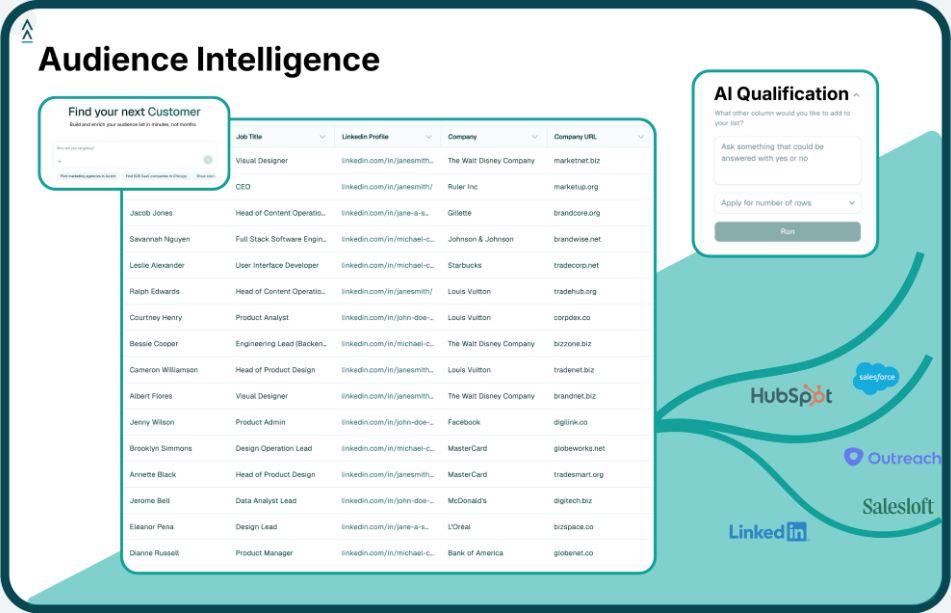
By combining the 300M+ contact database with 1,500+ unique signals across firmographic, technographic, intent, hiring, and funding data, Landbase helps go-to-market teams build targeted prospect lists in seconds rather than days. This acceleration is particularly valuable for low-code platform vendors who need to reach the right technical decision-makers at organizations ready to embrace rapid application development.
The VibeGTM interface allows users to input plain-English prompts like "CTOs at mid-market financial services companies evaluating low-code platforms" and receive AI-qualified exports ready for immediate activation in existing sales and marketing tools.
This list represents the fastest-growing low-code and no-code platforms based on several key criteria:
The explosive growth of the low-code market creates significant opportunities for go-to-market teams who can efficiently identify organizations ready to invest in digital transformation. According to Gartner, 70% of new applications will use low-code or no-code technologies by 2025, representing a massive addressable market.
However, successful go-to-market requires more than just a large database—it demands real-time intelligence about organizational readiness and buying intent. This is where platforms like Landbase provide critical advantages by combining real-time intent signals from website behavior, technology adoption, and market activities with comprehensive firmographic and technographic data to identify ideal customer profiles.
For vendors in the low-code space, this means the ability to target organizations actively evaluating development platforms, hiring for relevant roles, or demonstrating other buying signals. For enterprises building solutions on low-code platforms, it means efficiently reaching prospects who can benefit from these rapid development capabilities.
Low-code platforms typically require some programming knowledge and are designed for professional developers to accelerate development through visual interfaces and pre-built components, while no-code platforms like Betty Blocks require zero programming skills and target business users. Low-code platforms generally offer more customization capabilities, complex integrations, and extensibility through custom code, making them suitable for enterprise applications with sophisticated requirements. No-code platforms prioritize ease of use and speed of deployment for specific use cases, enabling citizen developers to build functional applications without IT department involvement.
According to Forrester research, low-code platforms can make software development as much as 10 times faster than traditional coding methods by eliminating repetitive coding tasks through visual development interfaces and pre-built components. These platforms provide drag-and-drop functionality for UI design, pre-configured templates for common workflows, automated code generation, and built-in integrations that would otherwise require weeks of custom development.
AI is becoming deeply integrated into low-code platforms, providing capabilities like AI-assisted logic creation in Mendix, AI Builder for intelligent automation in Microsoft Power Apps, AI-powered data fabric in Appian, and predictive analytics modules in Creatio. These AI capabilities help automate routine development tasks such as suggesting optimal workflow configurations, generating code from natural language descriptions, and identifying potential bugs or security issues before deployment.
Businesses should evaluate low-code ROI by measuring development speed improvements through comparing project timelines before and after platform adoption, reduced developer headcount requirements as business users build simple applications, faster time-to-market enabling revenue generation from new digital products, and improved business user satisfaction through self-service application development. Organizations should also consider indirect benefits including increased agility to respond to market changes, reduced technical debt through standardized development practices, and improved collaboration between IT and business teams.
Go-to-market teams can use AI-powered audience discovery platforms like Landbase to identify prospects based on real-time signals indicating digital transformation readiness and low-code platform evaluation. Key signals include technology stack changes showing adoption of complementary tools, hiring for digital transformation roles or low-code developer positions, recent funding rounds indicating available capital for technology investments, and attendance at relevant technology conferences or webinars focused on application modernization.

Tool and strategies modern teams need to help their companies grow.






