.png)
.png)

Daniel Saks
Chief Executive Officer


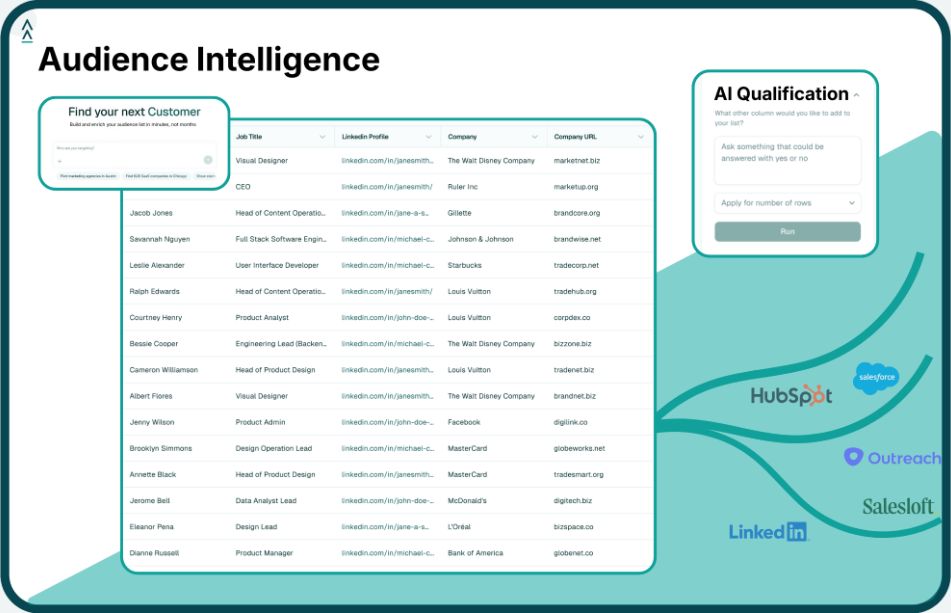
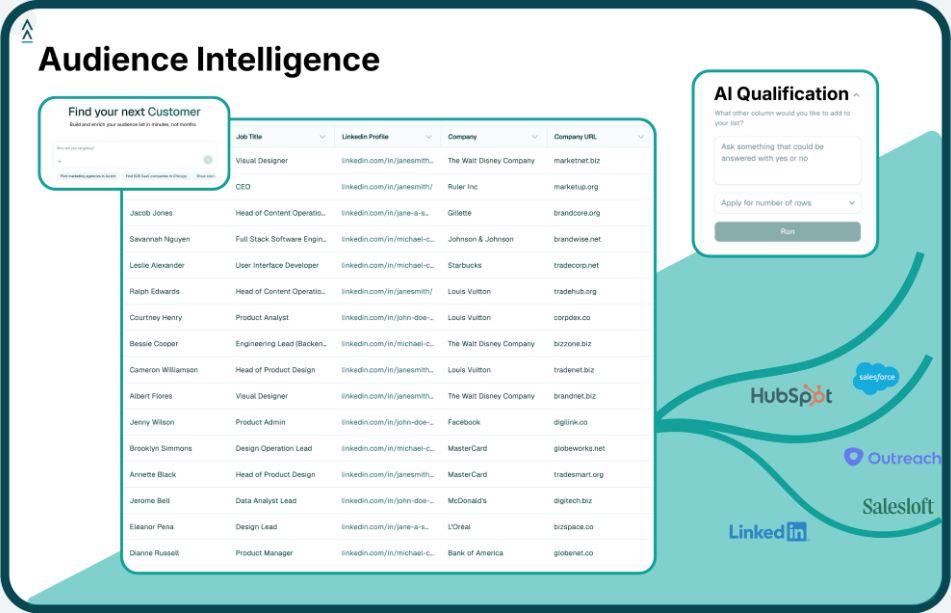
The Industrial IoT market is undergoing explosive growth, valued at $483.16 billion in 2024 and expected to expand at a CAGR of 23.3% from 2025 to 2030. This transformation is being driven by companies leveraging AI, predictive maintenance, and connected devices to revolutionize manufacturing, energy, and logistics operations. For go-to-market teams in the IIoT space, identifying and reaching the right decision-makers at these innovative companies requires sophisticated audience intelligence. Platforms like Landbase enable IIoT vendors to build targeted prospect lists using natural-language prompts like "CTOs at growth-stage IIoT companies that recently raised funding," instantly generating AI-qualified audiences from a database of 300M+ contacts with 1,500+ unique signals.
Eswin Computing develops integrated chips focusing on IoT connectivity and AI data processing. For cellular IoT applications, the company produces WAN IoT ICs operating under Cat.1 and Cat1 bis connectivity protocols, which are particularly popular in China and driving significant growth in the cellular IoT module market.
Eswin Computing is the only IoT startup globally to surpass $1 billion in total funding, representing China's push for semiconductor independence. Their chips fuel the recent upswing in cellular IoT module market in China and the company operates at high-volume chipset production levels. The company's unprecedented funding demonstrates exceptional market confidence in their technology and position.
CEO: Information not publicly disclosed
Founded: 2016
Headquarters: China
Series C: $395.2 million (2021+)
Armis provides a cyber exposure management platform that discovers, secures, and manages every asset in an organization's environment. The agentless platform offers real-time visibility and protection for IT, cloud, and IoT devices across enterprise, finance, healthcare, retail, and public sectors.
Armis leads the cybersecurity-focused IIoT sector with $1.17 billion in total funding and a $6.1 billion valuation demonstrating unicorn+ status. An impressive 20% of Fortune 100 companies use Armis, validating the platform's enterprise-grade capabilities. The company's $435 million funding round showcases exceptional investor confidence in their cyber exposure management approach.
CEO: Yevgeny Dibrov (Co-Founder)
Co-Founders: Nadir Izrael, Tomer Schwartz
Founded: 2015
Headquarters: San Francisco, CA
Private Equity: $6.1B valuation
Claroty builds a cybersecurity platform designed to protect cyber-physical systems including industrial IoT, IIoT, and OT assets. The platform offers visibility, threat detection, remote access, and asset risk management for critical infrastructure across energy, manufacturing, and utilities.
Claroty ranks as one of the most heavily funded industrial cybersecurity companies with $740 million in total funding. Their $400 million Series E included the strategic acquisition of Medigate, expanding their capabilities into healthcare IoT security. The platform is trusted by top pharmaceutical companies, electric utilities, and manufacturers to protect industrial control systems across critical infrastructure sectors.
Co-Founders: Amir Zilberstein, Benny Porat, Galina Antova
Founded: 2015
Headquarters: New York, NY
Series E: $400 million including acquisition of Medigate
Figure develops autonomous, general-purpose humanoid robots aimed at addressing workforce challenges such as labor shortages and unsafe job tasks in manufacturing. The robots leverage AI and human-like agility for deployment in industrial facilities.
Figure secured a $675 million Series B in 2024, making it the second-highest funded US IoT startup. The company landed a commercial agreement with BMW for deployment in their Spartanburg, SC facility, demonstrating real-world industrial adoption. Figure addresses the critical skilled labor shortage—a major industrial challenge—while representing the powerful convergence of AI, robotics, and industrial IoT.
CEO: Brett Adcock (Founder)
Founded: 2022
Headquarters: United States
Series B: $675 million (2024)
Augury builds end-to-end AI-powered solutions for manufacturing enterprises, trained by the world's largest machine data library. The platform delivers predictive and prescriptive insights for machine health and process optimization, helping eliminate downtime and improve operational efficiency.
Augury leads the IoT in Manufacturing sector with $369 million in total funding and has diagnosed 100,000+ machines globally. A Forrester TEI™ Study demonstrates 310% ROI with less than 6 month payback period. Blue-chip customers include PepsiCo Labs, Mondelēz International, Colgate-Palmolive, Sanofi, and Tata Group. The platform saves a machine from failure every 43 minutes, helping customers avoid 552K downtime hours annually.
CEO: Elan Greenberg
Founded: 2011
Headquarters: United States and Israel
Total Funding: $369 million
Tulip provides a composable frontline operations platform with AI, machine learning, and a no-code app builder for enhancing productivity and operational excellence in manufacturing. The platform enables manufacturers to build interactive applications for production tracking, quality inspection, digital work instructions, and electronic batch records without coding.
Tulip secured a $120 million Series D in January 2026—one of the largest recent funding rounds in industrial IoT. The company is recognized as a 2025 Leader by G2 and IDC MarketScape for Manufacturing Execution Systems. Customers report 30-70% reduction in defects, 30% faster production, and $1M+ operational cost savings. Tulip validates MES in 6 months versus the 12-18 month industry average.
CEO: Natan Linder (Co-founder)
Founded: 2014
Headquarters: Cambridge, MA
Series D: $120 million
Wiliot provides battery-free, self-powered IoT tags (IoT Pixels) that connect products to the internet, enabling manufacturers to gain visibility into product usage, location, condition, and lifecycle. The patented technology harvests energy from ambient RF signals.
Wiliot's $200 million investment from SoftBank Vision Fund 2 validates the massive market potential for ambient IoT. The battery-free operation eliminates maintenance requirements and enables long-term tracking applications. Wiliot enables item-level tracking for manufacturing and logistics while the battery-free design aligns with environmental sustainability goals, removing a major barrier to widespread IoT deployment.
CEO: Tal Tamir
Founded: 2017
Headquarters: Tel Aviv, Israel
Series C: $269 million including $200M from SoftBank Vision Fund 2
Cognite provides an AI-based production data analysis platform that unifies, contextualizes, and activates industrial data through Cognite Data Fusion® and Atlas AI™. The platform enables manufacturers to deploy Industrial AI agents for autonomous decision-making and workflow optimization.
A Forrester TEI study demonstrates 400% ROI and $21.6M total benefits from Cognite's platform. The company recently opened its Arizona global headquarters in December 2025, signaling continued expansion despite acquisition. Strategic partnerships with Snowflake, NVIDIA, SBM Offshore, and SLB validate the platform's enterprise capabilities. Customers achieve measurable impact in just 7 weeks from deployment and scale to 9 facilities in 4 months.
CEO: Girish Rishi
Founded: 2016
Headquarters: Lysaker, Norway (with Arizona global HQ opened December 2025)
Total Funding: $225 million (acquired in 2022 but continuing rapid expansion)
Seeq provides industrial data analytics solutions that enable process manufacturers to rapidly investigate and share insights from time-series data. The platform helps engineers and data scientists analyze production data to improve quality, increase throughput, and reduce waste.
Seeq ranks as the #2 top IoT in Manufacturing company globally by Tracxn, demonstrating exceptional market validation. The company's total funding of $165 million Series D indicates strong market demand for specialized process manufacturing analytics. Seeq is purpose-built for continuous manufacturing in pharma, chemicals, and energy sectors and is featured across multiple industrial IoT market reports.
CEO: Dr. Lisa Graham
Founded: 2013
Headquarters: Seattle, United States
Series D: $165 million
Tractian provides an industrial copilot combining AI-powered condition monitoring sensors with an integrated CMMS platform. The company specializes in vibration analysis, predictive maintenance, and operational efficiency tracking for manufacturing plants.
Tractian raised $120 million in Series C funding on December 5, 2024, signaling rapid expansion momentum. The platform is deployed across food & beverage, CPG, and aerospace manufacturing sectors. Tractian positions itself with the "most advanced fault-diagnostic tool in the market" and helps manufacturers prevent unplanned downtime through real-time diagnostics and predictive insights.
CEO: Igor Marinelli
Founded: 2019
Headquarters: Brazil with United States operations
Series C: $185.6 million (2024)
MaintainX provides AI-driven insights to optimize equipment maintenance, reduce downtime, and enhance asset management for industrial teams. The platform combines computerized maintenance management (CMMS) with IoT sensors and predictive analytics to prevent equipment failures before they occur.
MaintainX secured a $150 million Series D in July 9 2025, demonstrating exceptional investor confidence. The company won a Deloitte Technology Fast 500™ award recognizing rapid growth. Customers report 30% reduction in unplanned downtime and 50% improvement in maintenance efficiency. MaintainX is pioneering natural language AI for maintenance workflows with their "Max AI" intelligence layer, with customers saving $50K+ on parts inventory costs per site.
CEO: Chris Turlica
Founded: 2014
Headquarters: San Francisco, CA
Series D: $150 million (July 2023)
Particle provides an IoT platform offering hardware, software, and connectivity services enabling businesses to easily create IoT devices and connect them to the internet. The platform includes development tools and cloud-based console for managing devices, data, and applications.
Particle's $40 million Series C demonstrates sustained growth and market validation. The comprehensive hardware-to-cloud solution reduces development complexity for industrial developers and system integrators. Particle serves industrial companies building custom IoT solutions, providing the foundational infrastructure needed to accelerate time-to-market.
CEO: Zach Supalla (Founder)
Founded: 2012
Headquarters: San Francisco, CA
Series C: $40 million
Sight Machine provides a digital twin platform and manufacturing analytics solution that transforms OT and IT data into AI-ready models for production optimization. The platform offers system-level twins, simulation capabilities, and enterprise AI to enable continuous production improvement.
Sight Machine recently launched a fully integrated Industrial AI solution with Microsoft, positioning for "complete AI stack to factory floor in weeks." The company serves the world's best manufacturers with a unified data foundation and ranks among the top 5 IoT in Manufacturing companies by Tracxn Score. Sight Machine has reached the $1 million revenue milestone and maintains a strategic partnership with Microsoft.
CEO: Jon Sobel
Founded: 2011
Headquarters: San Francisco, United States
Series D: $85.5 million
The industrial IoT market is transforming how manufacturers, energy companies, and logistics providers operate. With $3.69 billion invested in IoT in manufacturing over the past decade, the sector is experiencing unprecedented momentum. This growth is driven by the need for operational efficiency, predictive maintenance, and data-driven decision-making in increasingly complex industrial environments.
Cybersecurity has emerged as a critical enabler, with security-focused companies representing a significant portion of the fastest-growing IIoT companies. Meanwhile, AI integration has become table stakes, with 61% of IoT startups now offering analytics capabilities. The geographic landscape is also evolving, with APAC startups increasing from 16% (2021) to 24% (2024) of global IoT startups
For companies selling into this space, understanding the funding landscape, technology focus, and leadership teams of these innovators is crucial for effective go-to-market strategies.
This list highlights the 15 fastest-growing Industrial IoT companies based on:
All companies were verified as active (2024-2026 data) and focused specifically on industrial rather than consumer IoT applications.
These fast-growing Industrial IoT companies represent significant opportunities for vendors serving the industrial technology ecosystem. However, effectively reaching decision-makers at these innovative companies requires sophisticated audience intelligence that goes beyond basic firmographics.
This is where AI-powered go-to-market platforms like Landbase become essential. IIoT vendors can leverage natural-language targeting to identify prospects based on the exact signals that matter most:
Landbase's GTM-2 Omni model interprets these plain-English prompts and leverages 1,500+ unique signals—including funding events, technology stack changes, hiring patterns, and conference attendance—to build and qualify targeted audiences instantly. The platform's b2b database includes 300M+ contacts and 24M+ companies, enabling IIoT vendors to export up to 10,000 AI-qualified contacts per session for immediate activation in their existing sales and marketing tools.
By combining real-time market intelligence with natural-language targeting, IIoT vendors can dramatically accelerate their sales cycles and focus their efforts on the highest-potential prospects at the companies driving industrial innovation.
Industrial IoT (IIoT) focuses on connecting industrial equipment, machinery, and infrastructure to optimize operations, improve safety, and increase efficiency in manufacturing, energy, and logistics environments. Consumer IoT connects everyday devices like smart speakers, wearables, and home appliances to enhance convenience and personal experiences. IIoT solutions prioritize reliability, security, and integration with existing industrial systems, while consumer IoT emphasizes user experience and mass-market appeal. The industrial applications demand much higher uptime, security standards, and integration complexity than consumer deployments.
The biggest challenges include cybersecurity concerns, integration with legacy industrial systems, data management complexity, and demonstrating clear ROI. As industrial environments become more connected, protecting critical infrastructure from cyber threats becomes paramount, especially with equipment lifecycles spanning decades. Many manufacturing facilities operate with equipment that's decades old, making integration with modern IoT systems challenging and expensive. Companies like Armis, Claroty, and Xage Security are addressing the cybersecurity challenge, while platforms like Cognite and Augury focus on data integration and ROI validation to overcome adoption barriers.
AI is accelerating IIoT growth by enabling predictive maintenance, autonomous decision-making, and real-time optimization that delivers measurable business value. Companies like Augury use AI to predict equipment failures with exceptional accuracy, while Tulip's platform uses AI to optimize manufacturing workflows and reduce defects by 30-70%. AI also powers cybersecurity solutions that can detect and respond to threats in real-time, protecting critical industrial infrastructure. This AI integration has become table stakes, with 61% of IoT startups now offering analytics capabilities, driving both innovation and funding in the sector.
ROI varies by application but can be substantial across the board. Augury customers report 5-20x average return on investment, while Cognite's Forrester TEI study shows 400% ROI with $21.6M total benefits for enterprise deployments. Tulip customers report 30-70% reduction in defects and $1M+ operational cost savings, while MaintainX customers see 30% reduction in unplanned downtime and 50% improvement in maintenance efficiency. These tangible benefits—often achieved within 6-12 months—are driving the rapid adoption and significant funding we see in the sector.
Tool and strategies modern teams need to help their companies grow.