.png)
.png)

Daniel Saks
Chief Executive Officer


The AI productivity revolution has reached an unprecedented inflection point in 2025, with enterprise spending surging to $37 billion—a 3.2x increase in just one year. From AI coding assistants saving developers hours daily to clinical documentation tools addressing physician burnout, these companies are redefining productivity across every industry. For go-to-market teams, knowing which platforms lead in AI-powered audience discovery and qualification is just as important as choosing the right productivity tools. Agentic AI platforms like Landbase now sit alongside these productivity leaders, transforming how teams find and engage their ideal customers.
Anysphere, operating as Cursor, provides an AI-powered coding assistant that integrates directly into developer IDEs. The platform enables developers to write, understand, and refactor code using natural language prompts. With features like contextual code suggestions and automated refactoring, Cursor has become essential for modern development teams looking to amplify individual developer output.
Cursor achieved unprecedented market adoption with 1 million+ developers demonstrating exceptional demand. The company secured two mega-funding rounds totaling billions in 2025 and experienced one of the fastest valuation surges in productivity tech history. Cursor addresses the critical shortage of software engineers by amplifying individual developer output through AI-powered assistance.
Anthropic develops the Claude family of AI models with an emphasis on safety, reliability, and enterprise readiness. The company's Constitutional AI approach prioritizes alignment and safety over raw capability, making it particularly attractive to enterprise customers with compliance and reliability requirements. Anthropic provides both API access and enterprise solutions for mission-critical applications.
Anthropic achieved 1,000% year-over-year growth reaching $3 billion ARR and unseated OpenAI as enterprise LLM leader with 40% market share (up from 24% prior year). The company dominates coding with 54% market share and has maintained an 18-month lead on coding leaderboards. Constitutional AI and safety-first approach addresses critical enterprise concerns around reliability and compliance.
OpenAI develops frontier AI models including the GPT-4 and o1 series, powering the ChatGPT platform for both individual and enterprise users. The company provides comprehensive API access enabling AI integration across industries, while ChatGPT serves as the default starting point for AI application development. OpenAI's models have become foundational components in countless productivity applications.
OpenAI raised the largest funding round in tech history at $40 billion in March 2025 and maintains the largest user base of any productivity AI tool with 500 million weekly active users. The company pioneered the generative AI era and continues setting the pace for model development. Strategic partnerships with major platforms, including deep integration with Microsoft, extend OpenAI's reach across enterprise workflows.
Databricks provides a unified data platform combining data warehousing and AI/ML capabilities through its Lakehouse architecture. The platform enables organizations to unify data silos while enabling secure AI development at scale. With 10,000+ enterprise customers, Databricks has become the foundational data layer for enterprise AI adoption across industries.
Databricks is the fastest-growing major enterprise software company at 60% YoY growth and provides critical data infrastructure powering AI applications across thousands of enterprises. The platform is strategically positioned as the default lakehouse layer for enterprise AI workloads and eliminates separation between analytics and AI that exists in traditional data warehouses.
Glean provides AI-powered enterprise search that indexes information across 100+ applications, creating a unified search experience for employees. The platform integrates with Slack, Gmail, Google Drive, internal databases, and other enterprise tools, allowing users to find information using natural language queries while respecting existing permissions and access controls.
Glean consistently raises mega-funding rounds including $150 million Series F in June 2025 and is backed by top-tier investors including Sequoia, Kleiner Perkins, and Lightspeed. The platform addresses critical enterprise productivity problem of information fragmentation and eliminates time wasted searching for information and reduces knowledge silos across organizations.
Harvey provides AI-powered legal research, contract analysis, and document drafting tools specifically designed for law firms. The platform uses foundation models customized for legal work, enabling lawyers to automate routine tasks while maintaining the precision required in legal practice. Harvey serves world's top law firms including Magic Circle and AmLaw 100.
Harvey achieved the fastest valuation increase in legal tech history, growing from $3 billion to $5 billion in 4 months. The platform serves 42% of AmLaw 100 firms, demonstrating category leadership, and reached $100 million ARR faster than most legal tech companies. Harvey shows that AI tools designed specifically for legal workflows can achieve rapid adoption among elite firms.
Abridge provides AI-powered clinical documentation that records and transcribes medical conversations, generating real-time clinical notes integrated with Epic and Cerner EHRs. The platform saves physicians 1-2 hours daily on documentation, directly addressing physician burnout caused by excessive administrative work. Abridge serves 100+ health systems across the United States.
Abridge achieved the fastest valuation growth in healthcare AI, doubling from $2.75 billion to $5.3 billion in 4 months. The platform addresses critical physician burnout by automating administrative work, allowing doctors to focus more on patient care. Healthcare AI spend reached $1.5 billion in 2025, with scribes capturing $600 million of that market.
Scale AI provides enterprise-grade data labeling and annotation services that support computer vision, NLP, and multimodal AI training. The company delivers high-quality, human-validated datasets at scale, serving both commercial enterprises and government/defense sectors. Without accurate, well-labeled data, even the most advanced AI models cannot perform effectively.
Scale AI raised one of the largest rounds of 2024 at $14.3 billion and provides critical data infrastructure enabling all other productivity AI tools. The company serves both commercial enterprises and government/defense sectors and addresses the fundamental challenge of AI development: the need for high-quality training data at scale.
Sierra provides AI agents for customer service automation that handle complex, multi-turn conversations using natural conversational AI. The platform integrates with existing customer service platforms and maintains brand voice while automating high-volume customer support interactions. Led by former Salesforce Co-CEO Bret Taylor, Sierra is rapidly gaining enterprise adoption.
Sierra achieved multi-billion dollar valuation in less than 2 years, one of the fastest ascents to unicorn status. Strong enterprise demand for automating high-volume customer support drives adoption. The platform represents convergence of AI agents and customer service productivity and addresses massive customer service market with potential to dramatically improve both customer experience and operational efficiency.
Together AI provides a cloud platform supporting 200+ open-source AI models with proprietary FlashAttention technology for high-performance inference. The platform serves both commercial and research use cases, offering pay-as-you-go API pricing that democratizes AI capabilities and allows organizations to avoid vendor lock-in while maintaining control over their AI systems.
Together AI achieved exceptional revenue growth surging from ~$30 million to over $100 million in under a year with valuation doubling significantly in the same period. The platform serves major enterprises including Salesforce, Zoom, and SK Telecom. Democratization of AI capabilities allows organizations to avoid vendor lock-in and maintain control over their AI infrastructure.
Cognition AI created Devin, the first autonomous AI software engineer that can complete end-to-end development tasks independently. The platform can plan, write, test, and deploy code autonomously, learning and improving from experience. This represents a paradigm shift from AI assistance to full autonomy in software development.
Cognition AI created the first autonomous AI software engineer, a revolutionary approach to developer productivity, and achieved multi-billion dollar valuation in less than 2 years from founding. Strong enterprise interest as companies explore autonomous agents to accelerate software delivery. The platform addresses the global shortage of software engineers through full automation of development tasks.
Hippocratic AI provides LLMs specialized for healthcare applications, with patient-facing AI agents for care coordination and appointment scheduling. The platform is purpose-built for healthcare environments with safety and compliance controls, addressing critical healthcare workforce shortages through AI automation of routine patient interactions.
Hippocratic AI raised two mega-rounds totaling substantial funding in 2025 and achieved exceptional valuation growth from $1.6 billion to $3.5 billion in 10 months. The platform addresses critical healthcare workforce shortages through AI agents for regulated clinical environments. Deployments across 20+ U.S. states demonstrate healthcare system adoption and validation.
While these 12 companies are transforming internal productivity across industries, they represent only half of the equation for business success. Having powerful AI tools in your stack is essential, but equally important is connecting these tools to the right customers at the right time.
This is where Landbase's agentic AI becomes critical. Just as Cursor helps developers write better code faster, and Harvey helps lawyers draft better contracts more efficiently, Landbase helps go-to-market teams find better prospects more effectively.
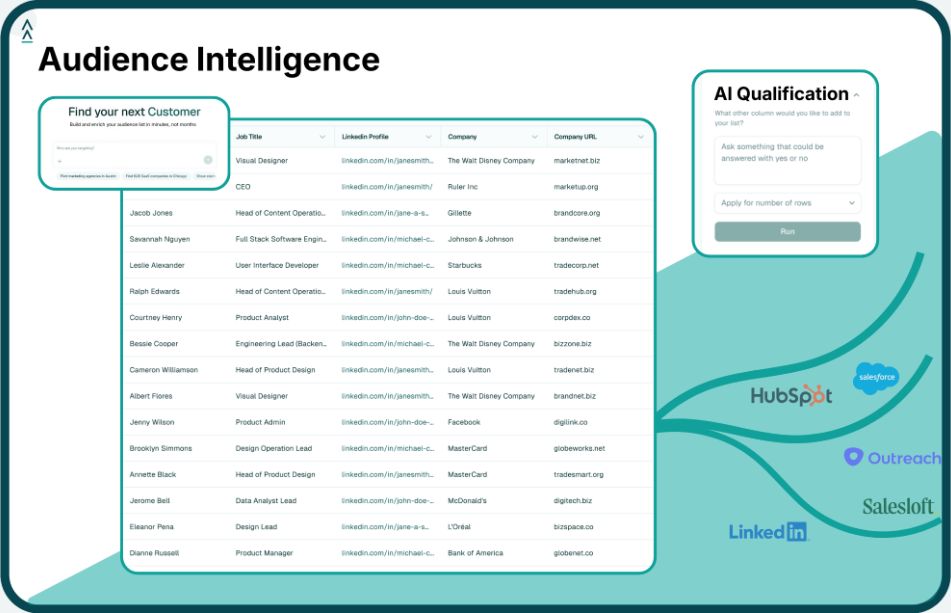
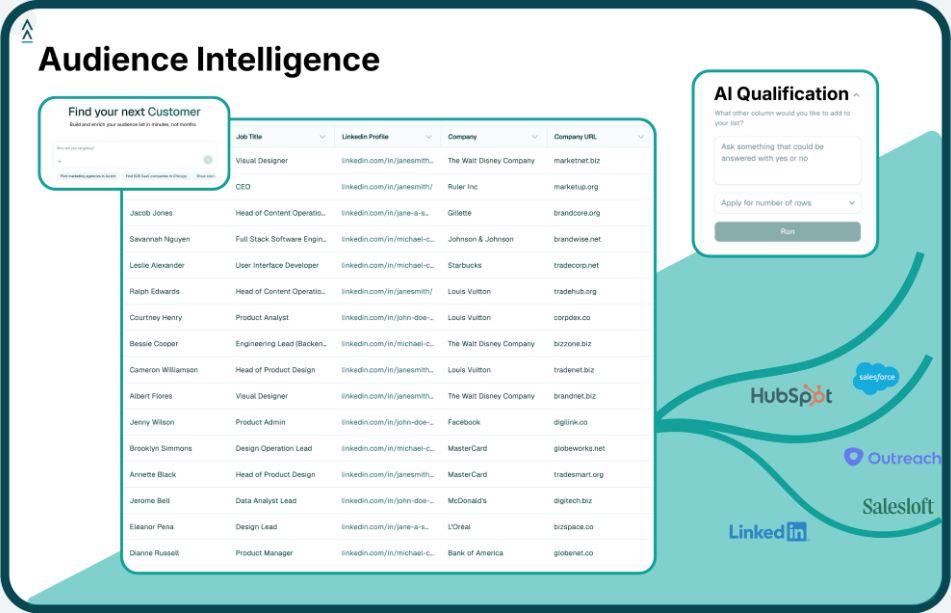
Landbase's VibeGTM interface allows sales and marketing teams to use natural-language prompts like "CFOs at enterprise SaaS companies that raised funding in the last 30 days" to instantly generate AI-qualified audiences. This approach complements the internal productivity gains from the companies listed above by ensuring teams are focused on the highest-value prospects.
The combination of internal AI productivity tools and external AI-powered audience discovery creates a complete AI-powered business workflow:
For B2B organizations competing in today's fast-moving market, this dual approach—optimizing both internal productivity and external targeting—is no longer optional. It's the new standard for business success.
AI enhances business productivity by automating routine tasks, providing intelligent assistance, and enabling better decision-making across organizations. In coding, AI tools like Cursor save developers hours daily on repetitive tasks. In legal work, Harvey automates research and contract analysis, freeing lawyers for strategic work. In healthcare, Abridge reduces documentation time by 50%+, addressing physician burnout. The enterprise AI market reached $37 billion in 2025, demonstrating the massive productivity gains organizations are achieving through AI adoption.
Top venture capital firms actively investing in AI productivity startups include Picus Capital, Sound Ventures (Ashton Kutcher's firm), Sequoia Capital, Kleiner Perkins, General Catalyst, and Thrive Capital. Landbase itself recently raised $30 million in Series A funding co-led by Picus Capital and Sound Ventures, demonstrating strong investor confidence in AI productivity tools. These firms are backing companies across the AI productivity spectrum, from foundation models to vertical applications, with unprecedented funding rounds reaching billions of dollars.
Yes, small businesses can significantly benefit from AI productivity tools, including free options that provide substantial value without significant investment. While many enterprise AI tools require paid subscriptions, Landbase offers free audience building with unlimited prompt searches and up to 10,000 exports per session. This democratizes access to sophisticated audience discovery for businesses of all sizes. Additionally, many AI productivity tools offer freemium models that allow small businesses to enhance productivity at no cost.
Landbase is unique because it focuses on go-to-market productivity rather than internal operational productivity like most AI tools. While most AI productivity tools help teams work more efficiently internally, Landbase helps teams find and engage the right customers externally. The platform combines 300 million+ contacts, 24 million+ companies, and 1,500+ unique signals with natural-language targeting to help B2B teams build qualified prospect lists in seconds. This external focus on revenue generation complements internal productivity tools, creating a complete AI-powered business workflow.
AI startups typically progress through seed, Series A, Series B, and later-stage funding rounds as they demonstrate market traction and growth. The companies listed in this article show the massive capital available for successful AI productivity tools, with recent funding rounds ranging from $126 million for Hippocratic AI to $40 billion for OpenAI. The enterprise AI market's rapid growth has attracted unprecedented venture capital investment, enabling AI startups to scale rapidly and achieve billion-dollar valuations in record time, sometimes in less than two years from founding.
Tool and strategies modern teams need to help their companies grow.