.png)
.png)

Daniel Saks
Chief Executive Officer


Most PropTech companies understand that lead generation isn't just about collecting contacts—it's about finding property owners, operators, and investors at the exact moment they're ready to solve specific operational challenges. PropTech sales involve complex buying committees of 8-13 stakeholders and consistent pipeline development becomes mission-critical for sustainable growth.
Today's most effective PropTech lead generation leverages building-level intelligence, asset-class-specific targeting, and real-time buying signals rather than generic "real estate" approaches. AI-powered audience discovery platforms are transforming how companies identify prospects who are not just demographically aligned with their ideal customer profile, but actively showing buying intent through property-level triggers like permit activity, energy performance issues, or compliance deadlines.
The science behind successful PropTech lead generation has evolved significantly. Companies implementing asset-class-specific segmentation are seeing 3-5x higher conversion rates compared to those using broad "commercial property owner" targeting. For PropTech companies navigating competitive markets with rising vacancy rates (20%+ in US offices) and ESG compliance pressures, understanding these modern frameworks can mean the difference between predictable revenue growth and constant pipeline uncertainty.
B2B lead generation for PropTech companies operates within a unique framework defined by physical asset validation, longer sales cycles, and increasingly sophisticated buyers with specific operational requirements. Unlike traditional B2B SaaS, PropTech businesses must demonstrate value at the building level before scaling to portfolio-wide implementations, creating a fundamentally different qualification process.
The modern PropTech buyer's journey has become more complex, with an average of 8-13 stakeholders typically involved in enterprise purchasing decisions. Each stakeholder brings different concerns—facilities directors focus on uptime and maintenance costs, CFOs evaluate total cost of ownership and compliance requirements, sustainability directors need emissions reporting and ESG metrics, and property managers care about tenant experience and operational efficiency. This multi-threaded buying process demands coordinated outreach strategies that address diverse perspectives within target accounts.
The challenge intensifies as 86% of B2B purchases stall during the buying process, and buyers conduct extensive self-research before engaging sales teams. With PropTech buyers spending only 17% purchase time with suppliers directly, companies must establish credibility and demonstrate value through digital channels long before any sales conversation begins.
For enterprise PropTech companies, the focus should be on quality over quantity—identifying accounts that match ideal customer profiles with precision. Startups, meanwhile, need speed and flexibility to test hypotheses quickly while conserving limited resources. Both require tools that can adapt to their specific go-to-market motions and scale with their growth.
The single most critical factor for PropTech lead generation success is asset-class-specific targeting. Companies that segment their ideal customer profiles by specific property types—office, multifamily, industrial, retail, healthcare—rather than broad "commercial property owners" achieve dramatically better results. One smart building platform increased demo acceptance from 11% to 38% and pilot conversion from 21% to 49% simply by rebuilding ICPs around asset-class-specific pain points.
Office owners prioritize vacancy reduction, space optimization, and energy efficiency in response to 20%+ vacancy rates. Multifamily operators focus on tenant retention, net operating income (NOI) improvement, and maintenance cost reduction. Industrial buyers need predictive maintenance, energy savings, and supply chain optimization. Each asset class requires different messaging, proof points, and ROI validation approaches.
AI-driven insights enable PropTech companies to move beyond basic firmographics to identify prospects based on 1,500+ unique signals including technographic data, intent indicators, and market events. Look-alike modeling further enhances targeting precision by identifying companies that share characteristics with existing successful customers, increasing the likelihood of successful engagement.
The key to successful ICP development lies in specificity rather than breadth. Companies should identify the specific operational challenges, financial metrics, and compliance requirements that drive purchasing decisions within each asset class, then build targeting criteria that reflect these real-world priorities.
The traditional approach of building complex filter combinations or purchasing generic real estate databases has given way to sophisticated, AI-powered platforms that combine natural language processing with intelligent qualification. Modern PropTech companies can now describe their target audience in plain English and instantly generate precisely qualified prospect lists.
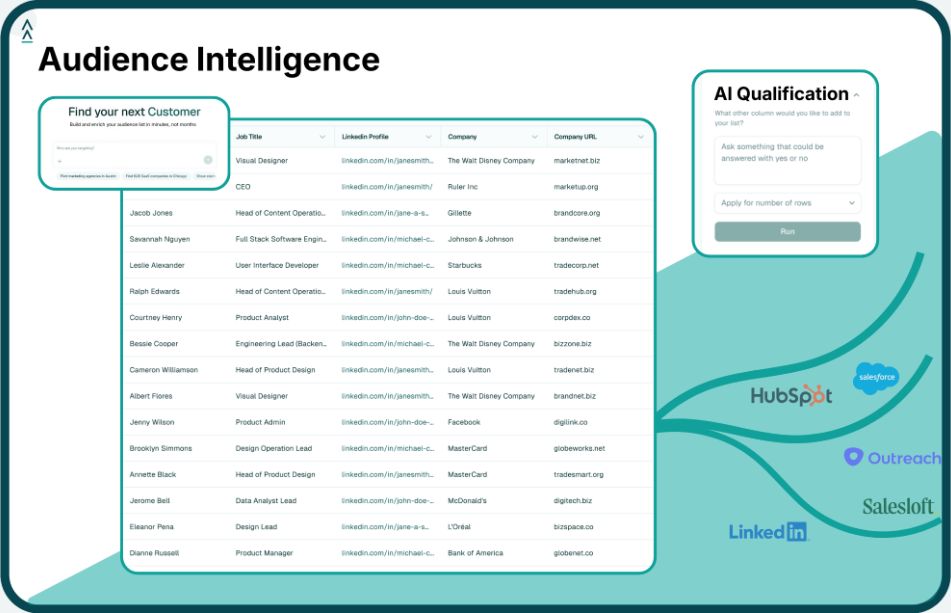
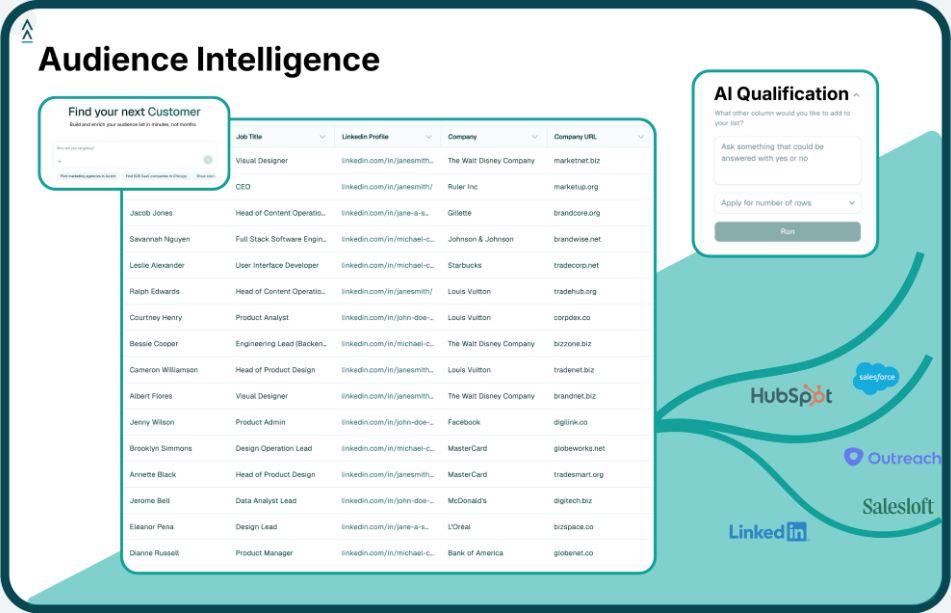
VibeGTM Interface represents the cutting edge of this evolution, enabling PropTech companies to build targeted audience lists using simple natural language prompts like "Property managers at multifamily REITs with 5,000+ units experiencing maintenance cost increases" or "Facilities directors at Class A office buildings in Chicago with Energy Star scores below 75." This eliminates the technical barriers and time investment required for traditional filter-based audience building.
The shift toward natural language platforms addresses a critical market need, with PropTech companies preferring specialized expertise over building in-house capabilities. However, the most successful companies maintain control over their targeting strategy while leveraging external platforms for execution efficiency.
Free access to advanced audience discovery capabilities has become increasingly important, especially for startups and growth-stage companies. Platforms offering no-login, instant audience generation allow teams to test targeting hypotheses quickly without lengthy procurement processes or significant upfront investment.
Generic real estate databases fail to provide the building-level intelligence that PropTech companies need to drive meaningful engagement. Successful PropTech lead generation requires data that goes beyond basic firmographics to include property-specific attributes, portfolio characteristics, and operational signals that enable true personalization.
The ability to reference specific buildings, addresses, Energy Star scores, occupancy rate changes, or recent permit activity achieves response rates of 4.8% versus 1.2% for generic messages. Meeting conversion improves from 0.9% to 2.3% when personalization includes property-level operational signals. This dramatic difference underscores why surface-level firmographics aren't enough for PropTech sales success.
Multi-source contact enrichment delivers complete prospect profiles including verified email, phone, social, and firmographic data, while advanced validation processes continuously monitor data accuracy and automatically update changed information. This ensures that outreach reaches the right stakeholders with the right context at the right time.
Data compliance remains critical, with PropTech companies requiring SOC II and GDPR compliance to ensure that contact information is ethically sourced and regularly validated. The best platforms combine premium data sources with proprietary enrichment while seamlessly integrating with existing CRM data.
The most sophisticated PropTech lead generation strategies leverage multiple data signals to identify prospects with genuine purchase intent. Beyond basic firmographic data like company size and industry, modern platforms track real-time indicators of buying readiness including building permit activity, energy performance issues, compliance deadlines, and technology stack changes.
These advanced signals enable much more precise targeting than traditional demographic approaches. For example, identifying "Property managers at multifamily buildings undergoing major renovations" provides a much higher probability of engagement than simply targeting "Property managers." The renovation activity creates immediate operational challenges and technology evaluation needs.
Landbase Intelligence provides in-market signals and insights, identifying PropTech companies with high buying potential based on intent. Real-time intent tracking becomes particularly valuable for enterprise PropTech sales, where timing can be as important as fit. Identifying prospects who are actively researching solutions, visiting relevant content, or engaging with compliance tools allows for perfectly timed outreach that capitalizes on existing interest.
Website visitor intelligence further enhances intent detection by tracking engagement with pricing pages, product information, and compliance resources. This behavioral data provides additional context about prospect interests and buying stage, enabling more relevant and timely outreach.
The integration of advanced AI into lead generation has transformed how PropTech companies approach audience building and qualification. Modern platforms go beyond simple contact collection to evaluate real-time buying intent through behavioral and contextual signals, then instantly generate qualified lists ready for immediate activation.
AI qualification evaluates both fit (does this prospect match our ideal customer profile?) and timing (are they actively showing buying intent?) through analysis of 1,500+ unique signals. This ensures that exported contacts are not just accurate but actively showing purchase intent, dramatically improving outreach effectiveness and sales conversion rates.
The ability to build AI-qualified lists and export up to 10,000 contacts instantly for activation reduces manual effort significantly while ensuring higher quality outreach. This speed and precision enable PropTech companies to respond quickly to market opportunities and maintain consistent pipeline development even with limited resources.
Look-alike modeling further enhances targeting precision by identifying companies that share characteristics with existing successful customers. This approach leverages historical conversion data to find new prospects with similar profiles, increasing the likelihood of successful engagement and reducing wasted outreach effort.
Multi-channel outreach has become essential for PropTech lead generation, with coordinated campaigns using email, phone, and LinkedIn in structured 8-12 touch sequences over 3-4 weeks reducing cost per lead by 31% compared to single-channel efforts. However, buyers now require multiple touchpoints across multiple channels to develop trust, making channel orchestration critical for modern PropTech selling.
Landbase Outbound & Nurture helps identify and qualify prospects, building targeted lists to move sales teams faster and more efficiently. The platform enables companies to create persona-specific nurture tracks with content tailored to each stakeholder's priorities—facilities directors receive uptime and maintenance focus, CFOs get total cost of ownership and compliance messaging, and sustainability directors see emissions data and ESG reporting capabilities.
Interactive ROI calculators addressing specific pain points (energy savings, space optimization, compliance costs, predictive maintenance) convert at 8.7% lead capture rates versus under 15% for generic content. An HVAC optimization platform saw calculator leads request demos at 44% compared to 15% for other content types, demonstrating the power of quantified value propositions.
Speed-to-lead becomes critical in competitive PropTech markets, with firms responding to inquiries within one hour 7x more likely to qualify leads than those responding later. This makes instant routing and calendar embeds essential for conversion, ensuring that interested prospects receive immediate attention.
Effective PropTech lead generation requires clear metrics and continuous optimization based on performance data. The shift from simple contact counts toward sophisticated qualification frameworks demands equally sophisticated measurement approaches that track performance across the entire customer journey from initial contact to portfolio-wide implementation.
Key Performance Indicators (KPIs) should align with business objectives and revenue outcomes rather than just activity metrics. While contact volume might indicate outreach activity, conversion rates, customer acquisition cost, and building-to-portfolio expansion rates provide more meaningful insights into lead generation effectiveness.
The complexity of modern PropTech buyer journeys—with prospects engaging across multiple touchpoints before purchase—makes attribution challenging but essential. Multi-touch attribution models that distribute credit across all interactions provide more accurate ROI measurement than last-touch models that only credit the final interaction.
Landbase Platform helps generate consistent pipelines without needing a large sales operation, supporting founders in scaling their B2B PropTech ventures. Continuous optimization requires regular feedback loops between sales and marketing teams, with shared definitions of lead quality, unified metrics, and regular performance reviews ensuring alignment and enabling rapid course correction when strategies underperform.
A/B testing becomes crucial for optimizing messaging, targeting criteria, and outreach channels. Companies should systematically test different approaches and scale what works while eliminating underperforming tactics. This data-driven approach to optimization ensures that lead generation efforts continuously improve over time.
When evaluating lead generation tools for PropTech companies, the focus should be on capabilities that enable building-level intelligence, asset-class-specific targeting, and multi-stakeholder engagement. The days of simple contact databases are over—today's effective platforms combine data accuracy with intelligent qualification and seamless integration.
Data quality remains the foundation of effective lead generation, with PropTech companies requiring building-level attributes, portfolio characteristics, and operational signals that enable true personalization. The best platforms go beyond basic firmographic data to include real-time signals like permit activity, energy performance issues, and compliance deadlines.
The rise of AI-powered platforms has raised the bar for what PropTech companies should expect from lead generation tools. Modern solutions should offer instant audience generation, AI qualification that evaluates both fit and timing, and seamless integration with existing outreach tools.
Agency partnerships can provide additional value for companies lacking internal expertise. Partners with deep PropTech domain knowledge can help refine ideal customer profiles, develop targeted messaging, and optimize outreach strategies based on industry-specific insights and best practices.
Landbase stands out in the crowded B2B lead generation landscape by combining agentic AI with instant, natural-language audience discovery specifically designed for PropTech companies. The platform addresses the unique challenges faced by both enterprise companies and startups through its frictionless approach to finding qualified prospects at the building and portfolio level.
The core innovation lies in GTM-2 Omni, Landbase's agentic AI model trained on 50M+ B2B campaigns and sales interactions. This allows users to simply type plain-English prompts like "Property managers at multifamily REITs with 5,000+ units experiencing maintenance cost increases" and instantly receive AI-qualified exports of up to 10,000 contacts ready for activation in existing tools.
Enterprise PropTech companies benefit from Landbase's precision targeting capabilities, enabling asset-class-specific campaigns that focus on high-value accounts showing real-time buying signals. Startups appreciate the speed and cost-effectiveness, with founder-led sales teams able to generate consistent pipeline without building complex in-house systems.
The platform's integration with existing tools like Gmail, Outlook, and LinkedIn ensures seamless workflow adoption, while the continuous learning from user feedback improves AI performance over time. For PropTech companies navigating competitive markets with 12-18 month sales cycles and complex buying committees, Landbase provides the precision, speed, and intelligence needed to find and qualify the right customers at the right time.
PropTech companies can use AI to improve B2B lead generation by leveraging natural-language targeting to describe their ideal audience in plain English, then receiving instantly qualified prospect lists based on 1,500+ unique signals. AI can identify prospects showing real-time buying intent through building-level triggers like permit activity, energy performance issues, or compliance deadlines. Additionally, AI enables multi-stakeholder identification across facilities, finance, sustainability, and IT teams within target accounts, ensuring comprehensive outreach to all decision-makers. This approach dramatically improves conversion rates compared to traditional demographic targeting.
The most important data signals for identifying PropTech prospects include building-level attributes (age, square footage, asset class, Energy Star scores), operational indicators (maintenance costs, occupancy rates, tenant turnover), compliance triggers (IFRS 16/ASC 842 deadlines, ESG reporting requirements, local emissions regulations), and real-time activity signals (building permits, technology stack changes, funding events). Property-level personalization referencing specific buildings achieves 4-7x higher response rates than generic firmographic targeting. This makes building-level intelligence essential for PropTech lead generation success.
Landbase currently integrates with Gmail, Outlook, and LinkedIn for seamless outreach activation. While CRM integrations with Salesforce, HubSpot, and Pipedrive are in development, users can easily export up to 10,000 contacts per session in standard formats for immediate import into existing tools. This export-and-activate approach ensures that qualified audiences can be leveraged in current workflows without requiring complex technical setup. The platform's focus on instant activation enables PropTech companies to maintain momentum in their outreach campaigns.
Natural language processing eliminates the technical barriers and time investment required for traditional filter-based audience building in the PropTech sector. Instead of spending hours constructing complex Boolean queries, users can simply describe their target audience in plain English and instantly receive AI-qualified results. This approach democratizes sophisticated audience discovery, making it accessible to non-technical users while maintaining the precision of advanced targeting criteria. It enables immediate testing of targeting hypotheses without lengthy setup processes, which is particularly valuable for PropTech startups.
Landbase ensures data accuracy through continuous validation processes that monitor and automatically update information across its 300M+ contact database. The platform combines premium data sources with proprietary enrichment while maintaining SOC II and GDPR compliance. AI Qualification evaluates both demographic fit and real-time buying signals from 1,500+ unique data points including building permits, energy performance issues, compliance deadlines, and technology stack changes. This ensures that exported contacts are not just accurate but actively showing purchase intent at the property and portfolio level.
Landbase is particularly well-suited for early-stage PropTech startups with limited sales teams because it offers free, no-login access that enables immediate audience generation without procurement delays or financial commitment. Founder-led sales teams can quickly test different targeting hypotheses using natural-language prompts, generating consistent pipeline without building complex in-house systems. The platform's focus on instant exports of up to 10,000 contacts per session allows startups to maintain outreach momentum while conserving limited resources. Additionally, the asset-class-specific targeting capabilities help startups focus on the highest-potential prospects showing real-time buying signals.
Tool and strategies modern teams need to help their companies grow.