Bad data and poor lead vetting are silent killers in go-to-market (GTM) teams – research shows 67% of lost sales result from reps not properly qualifying prospects, and poor data quality drains an average of $12.9 million per year from companies. With sales, marketing, and RevOps teams under pressure to hit targets efficiently, every mis-targeted email or call on a wrong-fit lead is wasted effort. It’s no wonder 81% of sales teams are now experimenting with AI solutions to boost pipeline precision and cut out the noise. In this post, we’ll unpack the difference between AI qualification and enrichment – two data-driven approaches that sound similar but play very different roles. You’ll learn why true qualification is foundational to precision GTM, how it goes beyond simple data enrichment, and how embracing AI-powered qualification can dramatically improve your conversion rates and ROI.
What is AI Qualification?
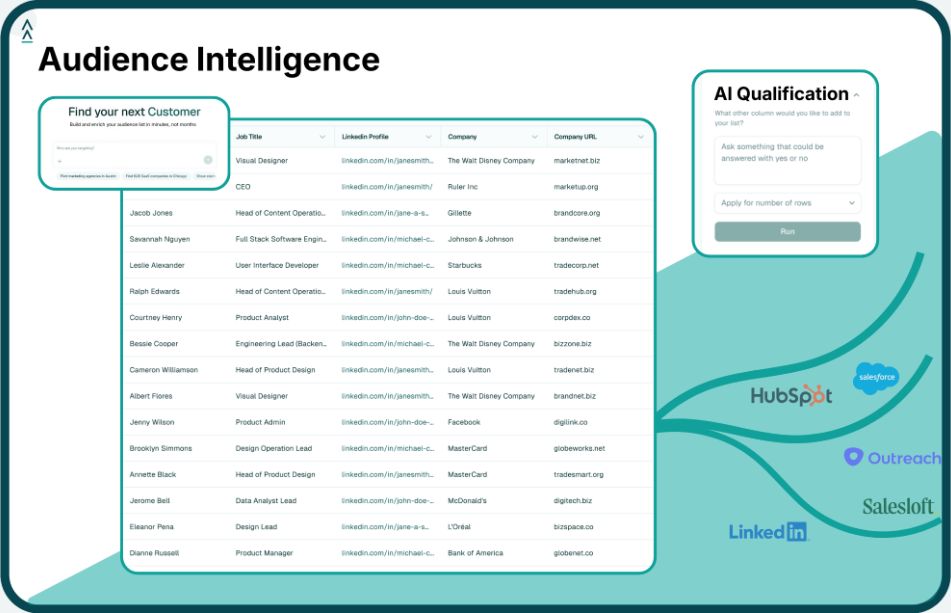
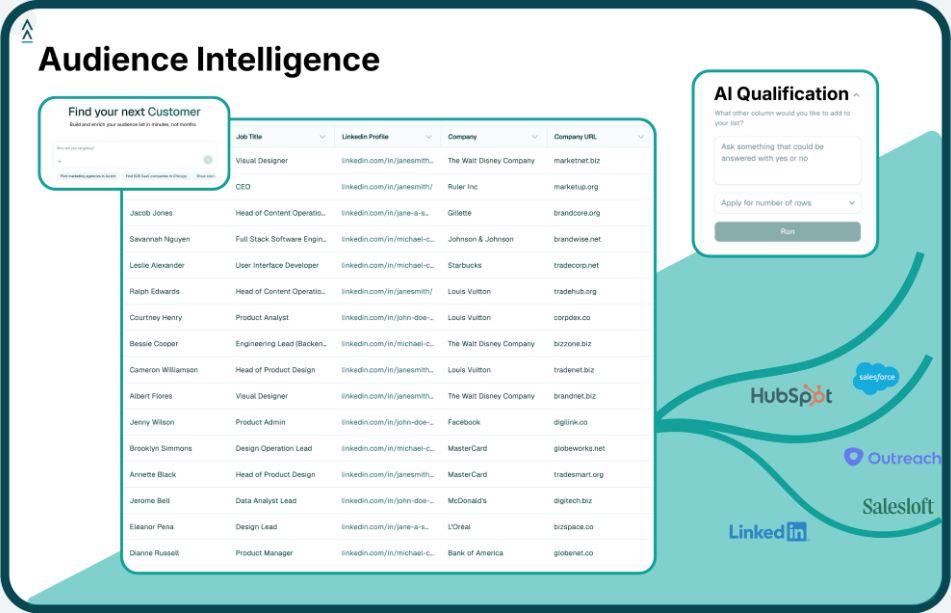
AI qualification is the process of using artificial intelligence to automatically verify and score leads or accounts against your predefined criteria to determine if they are truly a good fit for sales. In traditional sales terms, it’s an automated form of lead qualification – evaluating whether a prospect meets the requirements of your ideal customer profile and is worth pursuing. But unlike manual qualification where reps research each lead or apply frameworks like BANT by hand, AI qualification performs these checks at scale and with greater consistency.
Think of AI qualification as a digital analyst combing through each contact and answering, “Does this prospect check all the boxes for us?” The AI will use rules and models you define – for example, “Company in the SaaS industry, at least 200 employees, using cloud infrastructure, and currently hiring data engineers”. It then cross-references live data signals and databases to see if each contact or account meets those specifics. The outcome is typically a binary Yes/No flag or a qualification score for each lead. In other words, AI qualification doesn’t just enrich a record with more data (though it may fetch data in the process) – it applies judgment based on that data, labeling some prospects as “Qualified” (fit to proceed) or “Disqualified.”
Crucially, AI qualification also entails data cleaning and validation as part of the process. Good AI qualification systems will correct or remove bad data (e.g. outdated titles, invalid emails) as they evaluate leads. They aim for “pipeline-ready” accuracy, meaning the contacts passing through are verified to be real, current, and matching your criteria. According to Landbase, AI qualification involves “binary qualification checks that score, clean, and validate B2B contacts/companies using Yes/No logic for pipeline-ready accuracy”. It’s an active filter that ensures your sales team works only with high-confidence, high-fit leads.
What is Enrichment?
Data enrichment is the process of adding missing information or additional data points to a record in your database to make it more complete and useful. If AI qualification is about vetting a lead, enrichment is about filling in the details. For example, say you have a list of prospect emails with little else. Enrichment could append each person’s full name, job title, company, industry, company size, LinkedIn profile, phone number, technographic data, and so on. The result is a richer dataset: instead of just an email address, you now have context about who this person is and where they work.
In practice, companies perform enrichment by leveraging third-party data providers or databases. A classic use case is when marketing acquires leads (through events, content downloads, etc.) and then uses an enrichment tool to automatically add firmographic details (e.g. annual revenue, number of employees, industry classification) and demographic details (e.g. job role, seniority) to each lead record. “Data enrichment…turns incomplete or outdated contact lists into accurate, actionable datasets”, often by “adding missing details, correcting inaccuracies, and keeping information up to date”. In short, enrichment tries to ensure you have a complete profile for each prospect.
The key thing to note is that enrichment does not decide if a lead is good or bad – it simply augments data. As one industry definition puts it, “Data enrichment is the process of adding missing information and additional data points to your raw data, making it more robust, accurate and actionable.” If a lead “Jane Doe” downloaded an eBook and only provided her email and company name, enrichment might tell you Jane’s title (say, Marketing Director), her company’s industry (Fintech), size (50-200 employees), and maybe what marketing software her company uses. This is valuable context for sales and marketing personalization. However, enrichment on its own doesn’t tell you whether Jane’s company is truly a qualified target for your product – it doesn’t measure that against your ideal customer criteria. It merely provides the raw material; the decision still has to be made whether Jane is worth a sales follow-up.
Key Differences Between Qualification and Enrichment
At a high level, enrichment appends data; qualification applies logic. Both are important data-driven practices for GTM teams, but they serve different purposes. Let’s break down the key differences:
- Purpose: Enrichment’s purpose is to complete and correct your data. It answers “What more can we know about this lead?” Qualification’s purpose is to evaluate and triage leads. It answers “Should we pursue this lead or not?” and “Does this lead meet our criteria?”
- Process: Enrichment typically pulls from static databases or sources to append fields (e.g. adding a missing phone number or industry code). It’s usually an automated lookup. Qualification uses rules or AI models to assess fit, often incorporating dynamic data. It might involve checking real-time signals (like recent hiring, funding news, or tech stack) and even using AI to interpret unstructured info (e.g. analyzing a LinkedIn bio to confirm a role).
- Output: Enrichment produces new or updated data fields attached to the contact record – for example, adding “Industry: Finance” or “Employee count: 250” to a CRM entry. Qualification produces a decision or score – for example, tagging a record as “Qualified: Yes” (passes all criteria) or “No” (fails criteria), sometimes with a score (e.g. 85% fit) or notes on why.
- Timing & Usage: Enrichment is often done as soon as a lead enters your system (or at scheduled intervals) to keep records fresh. It’s about data quality and completeness upstream. Qualification is usually done before passing a lead to sales or moving it further down the funnel – essentially as a gate or filter. It might be continuous as new data comes in, but its critical point is right when deciding if a lead is sales-ready.
- Impact on Workflow: Enriched data helps sales and marketing teams tailor their outreach and messaging – knowing a lead’s details makes personalization possible. Qualification helps teams focus their time – by filtering out poor-fit leads, it prevents sales from wasting effort. For instance, without good qualification, marketing might dump 1000 leads on sales after a campaign; if only 200 meet the real criteria, those other 800 would waste the sales team’s time chasing prospects that won’t convert. Qualification ensures those 800 are identified and set aside (or nurtured differently) early on.
Why GTM Teams Can’t Rely on Enrichment Alone
If your strategy has been to enrich lists of leads and hand them off to sales, you’re likely familiar with the drawbacks of that approach. While enrichment is valuable, GTM teams cannot rely on enrichment alone to drive pipeline quality. Here’s why:
- Enriched data can be inaccurate or stale. Adding more fields doesn’t guarantee those fields are correct. In fact, data quality remains a huge problem in B2B databases – studies confirm that 70% of CRM data is outdated, incomplete, or inaccurate on average. People change jobs, companies pivot, and information decays. A contact record enriched six months ago may now have the wrong phone number or an outdated title. Most enrichment providers update their data periodically, but not in real time. If you rely solely on enrichment, you might be calling a lead who left the company last month or emailing someone whose role has changed. Regular verification (qualification) is needed to catch these changes.
- Volume ≠ quality. Enrichment tends to encourage a “more is better” mindset – the more data you append and the more leads you stuff into the funnel, the greater your chances, right? In reality, more unqualified leads just mean more noise. Marketing teams often dump every enriched lead to sales: surveys show 61% of B2B marketers send all leads directly to sales, yet only 27% of those leads are actually qualified to begin with. The result is sales reps drowning in contacts that look detailed on paper but aren’t truly viable buyers. This creates frustration and inefficiency. Without a qualification step, enrichment can give a false sense of pipeline fullness. It’s like having a detailed map of a territory where 75% of the towns are ghost towns – the detail doesn’t help if most of them lead nowhere. Indeed, roughly 75% of marketing leads typically don’t qualify for direct sales engagement, and 79% never convert to sales in the end. That’s an enormous waste if enrichment is your only strategy; you end up with well-documented bad leads.
- Missed prioritization and ICP focus. Enrichment doesn’t inherently rank or prioritize leads – it treats a Fortune 500 enterprise and a tiny startup the same when appending fields. Qualification, on the other hand, would likely flag one of those as higher priority if your ICP favors larger enterprises (or vice versa, depending on your strategy). GTM teams need to focus on precision: targeting the right segments and accounts that are most likely to buy. If you only enrich data, you might have lots of information but no clarity on who your best prospects are. For example, say you enriched 1,000 new leads from a trade show with job titles and industries. Without qualification, a junior marketer at a non-target industry might look as “complete” a record as a C-suite exec at an ideal industry – your reps might waste time hitting up all 1,000 equally. Qualification introduces a filter to ensure the leads that don’t align (e.g. too low-level, wrong industry, inadequate budget indicators) are removed or deprioritized immediately.
- Inability to capture dynamic signals. Modern buying intent and fit often reveal themselves in dynamic, real-time signals – things like a company’s recent funding, job postings, technology adoption, or news mentions. Traditional enrichment might not capture these well, or only does so infrequently. Qualification can incorporate live signals to verify a lead’s fit. For instance, if your product sells well to companies “actively hiring data scientists,” a static enrichment might have a field for “hiring: yes/no” that’s outdated; an AI qualification approach could actually check the company’s careers page or LinkedIn postings in real time to see if they are indeed hiring for that role this month. This kind of real-time evidence is critical to truly qualify leads, and it’s where enrichment alone falls short. Relying only on enrichment means you might act on old information and miss the context of timing and intent.
In summary, enrichment is necessary – you do need complete data to inform your strategies – but enrichment is not sufficient for a high-performing GTM operation. A telling statistic: only 25% of marketing-generated leads are typically high enough quality to advance to sales, yet without robust qualification, many organizations still pass along 100% of leads to sales. No wonder sales reps often complain about lead quality. It’s critical to introduce AI qualification as a refinement layer on top of enrichment: enrichment fills in the blanks, and then qualification separates the wheat from the chaff.
Real-Time vs. Offline Qualification (Understanding AI Modes)
Not all qualification is equal, especially when AI is involved. Leading platforms (like Landbase) offer two modes of AI qualification to balance speed and thoroughness: offline qualification and online (real-time) qualification. Let’s clarify the difference and why GTM teams benefit from both:
- Offline AI Qualification (Batch Mode): Offline doesn’t mean without internet; it refers to using pre-indexed data and signals to verify leads rapidly. Think of this as a fast, high-volume pass through your data. You upload a list or connect your database, and the AI checks each record against known datasets and signals it already has. For example, Landbase’s offline qualification can process up to 10,000 records per run, typically completing in minutes. It leverages a rich B2B database (e.g. 300M+ verified contacts with 1,500 signals) to decide if each contact meets your criteria. This is ideal for bulk cleaning and scoring of lead lists. Say you have a CSV of 5,000 inbound leads from various sources – an offline qualification run could quickly flag which ones fit your ICP (Yes/No) based on data points like industry, employee count, etc., that the system already knows or has indexed. It’s instant insight at scale, great for preparation before a big campaign or for routine data hygiene. The trade-off is that offline mode relies on existing data; if a particular field is empty or ambiguous in the database, offline qualification might mark the contact as “unknown” or pass it to the next stage rather than definitively qualify/unqualify.
- Online AI Qualification (Real-Time Mode): Online qualification kicks in when the existing data isn’t enough to make a confident call. It’s essentially real-time research on a lead. This mode uses live web crawling, APIs, and large language model (LLM) reasoning to gather missing information or validate uncertain details on the fly. For instance, if a contact’s company size isn’t in the database, an online qualification might visit the company’s website or LinkedIn to estimate employee count, or use an AI to interpret the company’s description to classify the industry. Online qualification is like having a virtual research assistant who will Google the lead, check news, and even read through text to determine if criteria are met. It’s extremely useful for ambiguous or edge-case leads – e.g., a niche industry prospect where data is sparse, or a new startup that isn’t yet in databases. The trade-off here is time: online qualification is slower, because live crawling and AI analysis take time (often seconds or more per lead, and if dozens of leads require deep research, it could take hours). Landbase notes that online runs typically complete within 24 hours for difficult cases, whereas offline runs finish in minutes. So, online is used selectively when needed, rather than for every single lead.
By combining offline and online methods, AI qualification platforms ensure you get both speed and completeness. The workflow often goes: run offline qualification first for the bulk of straightforward decisions, and automatically escalate any “can’t decide” cases to online qualification. From a GTM perspective, this means you can confidently qualify thousands of leads very quickly, but you also have a safety net that no lead falls through the cracks due to missing data. The online mode will find that missing piece of info or confirm a hunch using external sources if necessary.
Landbase’s own AI Qualification feature highlights this balance: it runs fast batch checks on indexed data for up to 10k contacts (offline mode) and automatically switches to live web research with LLMs for any unknowns (online mode). The result is high-confidence output: you get a list of leads where each one has been either immediately qualified via known facts or thoroughly researched to resolve ambiguity. For GTM teams, this means you can trust the qualified list that comes out the other end – it’s both comprehensive and precise.
How AI Qualification Improves Precision and ROI
Investing in AI qualification pays off in a very tangible way: better pipeline outcomes and higher return on your go-to-market efforts. By ensuring that only the right prospects enter and move through your funnel, AI qualification drives several key improvements:
- Higher Conversion Rates: When you rigorously qualify leads, the contacts that reach your sales team are inherently more likely to convert. This isn’t just theory – it’s backed by data. Properly qualified leads have been shown to achieve around 40% conversion rates, versus only 11% for unqualified prospects. That’s nearly a 4X lift in efficiency. It makes intuitive sense: if your sales reps are only talking to prospects that genuinely fit your product and have a verified need or interest, the odds of closing are much higher. In contrast, a rep who spends time on random or poorly-fitting leads might close only a small fraction (hence the 11% figure for unqualified). By implementing AI qualification, one company aligned its marketing and sales criteria and saw MQL-to-SQL conversion improve significantly – remember that 87% of marketing-qualified leads currently never make it to Sales Accepted Leads without better qualification. Closing that gap means more of your marketing spend translates into real pipeline.
- Shorter Sales Cycles & Better Win Rates: Qualified prospects not only convert at a higher rate, they often move faster through the funnel. They have the right budget, authority, need, and timing – so there are fewer hiccups or delays. According to Salesforce data, companies that emphasize lead qualification see sales cycles shorten and win rates increase on average. Reps are no longer chasing ghosts or waiting on unresponsive leads to miraculously turn interested. Instead, they engage with genuinely interested, good-fit buyers who progress naturally. Moreover, a well-qualified pipeline improves forecast accuracy – deals in the pipeline are real, so sales projections and revenue planning become more reliable.
- Massive Time Savings and Productivity Gains: One of the biggest ROI factors of AI qualification is the time it frees up for your team. Sales reps notoriously spend a huge chunk of their day on non-selling tasks (researching leads, updating records, prospecting widely). By automating qualification, you hand a lot of that grunt work to the AI. Studies indicate sales representatives spend only about 34% of their time actually selling, with the rest lost on admin and prospecting tasks. A large portion of that non-selling time is wasted on trying to find or vet good leads. AI qualification slashes this waste. In fact, early disqualification of poor-fit prospects can save roughly 32% of sales time that would otherwise be squandered chasing dead ends. Consider an average sales rep – if they have ~500 working hours per year spent on prospecting and data hygiene, even a partial automation could give back dozens of days of productivity. Landbase’s research found reps lose about 500 hours a year (62 working days) just validating and correcting contact data ; AI can recapture most of that time. For a GTM org, that means either smaller teams can do the same work or the same team can handle far more qualified opportunities with the time saved.
- Improved Marketing ROI and Alignment: AI qualification doesn’t just help sales – it dramatically improves marketing efficiency too. When marketing knows the AI will qualify leads against strict criteria, they can tailor campaigns more precisely and worry less about volume for volume’s sake. The classic war between marketing (often measured on lead volume) and sales (measured on lead quality) diminishes. Both teams start speaking the same language of quality. With AI filters catching mismatches, marketing can analyze which channels or campaigns produce the most qualified leads (not just the most leads) and optimize accordingly. Over time, this feedback loop increases the percentage of marketing leads that convert, effectively boosting the ROI of marketing spend. Also, having an automated qualification engine forces clear definition of ICP and qualification criteria, which aligns marketing and sales on what a “good lead” looks like. This kind of alignment can prevent the common scenario where marketing passes a high volume of leads but sales ignores 79% of them as low quality. Instead, every lead that makes it through AI qualification is one sales will accept, because the criteria were agreed upon upfront.
- Scalability and Consistency: Human-driven qualification can be inconsistent – one rep might be strict, another lenient; one might excel at research, another might drop the ball. AI qualification provides consistency at scale. Every lead is evaluated against the same benchmarks, with the same thoroughness, no matter how many leads flood in. This is crucial for scaling GTM efforts. If you plan to expand demand generation and double your lead volume next quarter, you don’t need to double your qualification headcount – the AI can handle the surge, and it will treat lead #10,000 with the same care as lead #10. Consistency also means compliance and fairness – e.g., if you have compliance criteria (like only target companies that meet certain regulatory conditions), an AI will apply that rule uniformly, reducing risk.
In financial terms, the combination of these factors – higher conversion, faster deal cycles, saved time, better marketing efficiency – yields a strong ROI. There’s a reason modern GTM orgs are adopting AI: a recent study noted that 83% of sales teams using AI have met or exceeded their growth targets, versus 66% of non-AI teams. And 74% of companies achieve a positive ROI on AI projects within the first year. AI qualification specifically zeroes in on one of the most important levers for ROI: the quality of your pipeline. By fixing pipeline inputs, everything downstream performs better.
Lastly, consider the downstream impact on revenue: If your sales team closes deals at, say, 20% on average, and you manage to give them fewer but 2x more qualified leads, you haven’t just improved efficiency – you’ve potentially doubled revenue from the same lead pool. It’s the classic “work smarter, not harder.” With AI doing the smart qualification work, your team can focus its hard work on what they do best: selling to the right people.
From Enrichment to Precision Qualification
Modern GTM teams have more data at their fingertips than ever – but simply having data (enrichment) is not enough. The winners in sales and marketing are those who can distill big data into actionable intelligence (qualification). AI qualification and enrichment are complementary, but as we’ve explored, qualification is the step that delivers true precision by ensuring your focus is on the right prospects. Enrichment will fill your database with lots of facts; AI qualification will tell you which of those facts actually signal a potential customer.
By integrating AI qualification into your workflow, you transform your approach from “spray-and-pray” to targeted and tactical. Your sales reps spend time with prospects who have a genuine need and fit. Your marketing campaigns hone in on segments that really matter. Your RevOps team sees cleaner data and more predictable conversions. It’s the foundation of what we call precision GTM – go-to-market motions guided by verified, high-quality insights rather than hunches or hasty list uploads.
.png)
.png)


.png)